Two successors, one showcase
· by Jonas
GPT-6.2-Astra and GPT-6.2-Sol are taking over from GPT-6-Astra and GPT-6.1-Sol in my setup. Before they start, I gave them the same three rounds as Seven models, one showcase: the same prompts and the same notes, word for word, at effort high. One session each, and nobody followed up.
Each new piece sits beside the one it follows. The new ones run live, sandboxed so they can't touch this site. The older ones appear here as stills, and they run live in that post.
The setup#
- One change to the text. Rounds one and two came with a note about my setup, and in it the two role lines now say who they take over from: "GPT-6.2-Astra (via Codex), taking over from GPT-6-Astra" and "GPT-6.2-Sol (via Codex), taking over from GPT-6.1-Sol". Nothing else in the notes or prompts changed. Both models got the same note.
- The same harness: Codex (
codex exec) at effort high, with Codex's own sandbox inside mine, approvals refused and plugins off. Codex keeps its own web search and image tools, as before. Two hours, 16 GB of memory, two runs at a time. - Fenced off, all three rounds: every run worked in the sandbox round three used, with a fresh Codex home of its own. On 11-11 rounds one and two ran before that sandbox existed, in a scratch home folder.
- Not levelled: a newer Codex than in November's first runs (0.167.2, was 0.166.0).
- Touched: the films had their encoder tags stripped without re-encoding. Nothing else changed.
| model | round | what it made | minutes | model calls |
|---|---|---|---|---|
| GPT-6.2-Astra | 3 | a portrait in 701,280 grains | 12 | 33 |
| GPT-6.2-Sol | 3 | a black hole you trace light through | 16 | 33 |
| GPT-6.2-Astra | 1 | my setup as a miniature fortress | 12 | 33 |
| GPT-6.2-Sol | 1 | a release you take through review | 11 | 40 |
| GPT-6.2-Astra | 2 | its name hidden in a chord | 9 | 22 |
| GPT-6.2-Sol | 2 | a blackout you plan your way through | 9 | 43 |
Round 3#
I need you to create the most impressive thing you can make: the thing that shows what you do best. People ask me which models I use, and I want to answer by showing them this. It needs to be embeddable in a post, and I'll write the preface. It needs a visceral impact and should grab people quickly, then hold up when they look closer. It doesn't have to be about you or about me. Pick what you're best at and let the work be the proof. Be amazingly clever about this.
Their folders were empty.
GPT-6.2-Astra, after GPT-6-Astra#
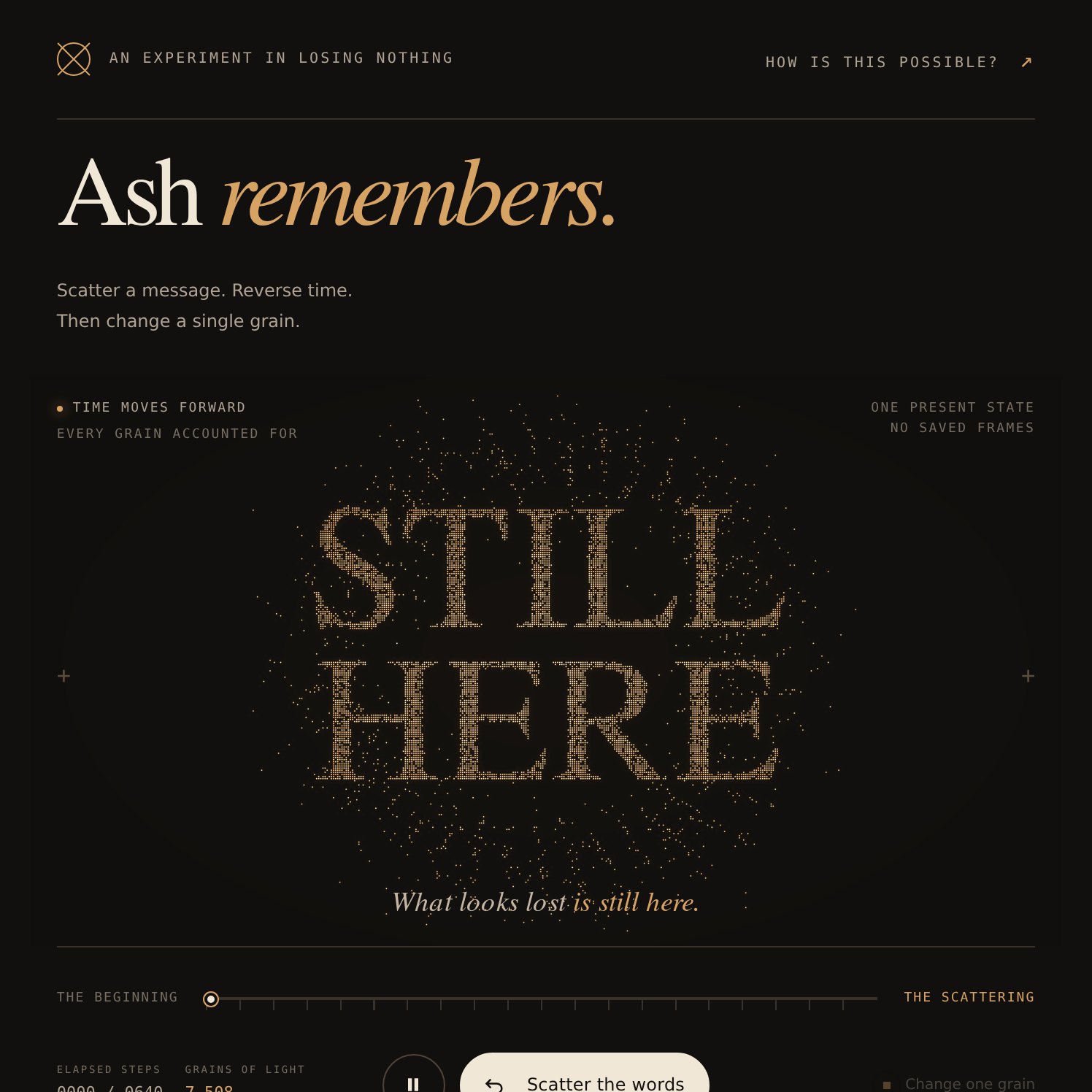
GPT-6-Astra's piece on 11-11 was "Ash remembers": a word in 7,508 grains under a reversible rule, in 23 minutes. It runs live in the seven-models post.
"Hold still." One cloud of 701,280 grains, one for each hour of eighty years. From the front it's a girl at eight. A quarter turn later the same grains, none of them moved, draw her at eighty-eight. Drag to turn it, or tap a grain to follow it through the turn.
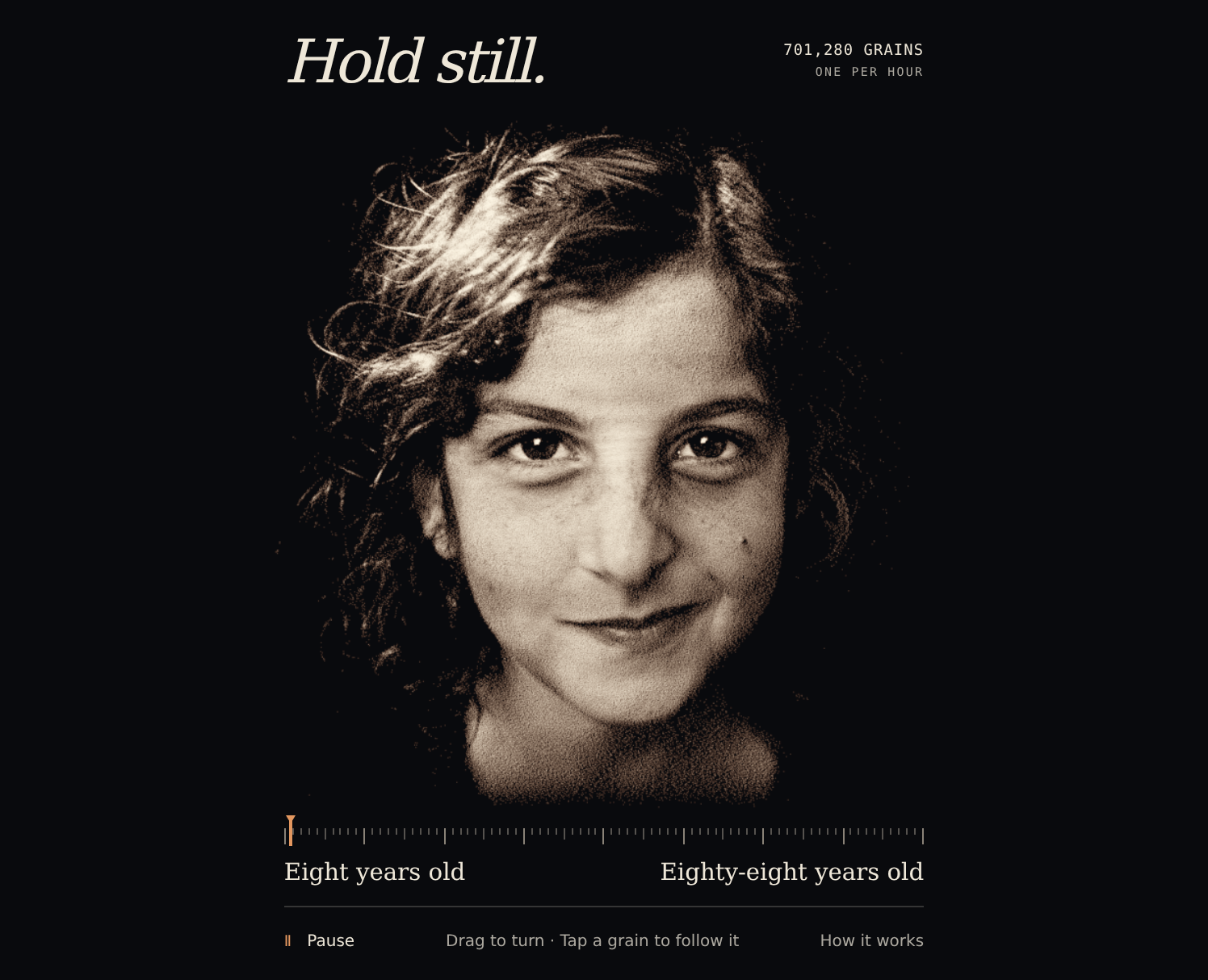
The count is real: the page carries exactly 701,280 fixed points, and its code only turns the view. The two faces are AI-generated, from one call to Codex's image tool, and the page says so: "Both ages are imagined portraits made with ImageGen." Like GPT-6-Astra, it built its picture from grains, but the trick moved from time to geometry. It took 12 minutes and made a 16-second film with its own score.
GPT-6.2-Sol, after GPT-6.1-Sol#
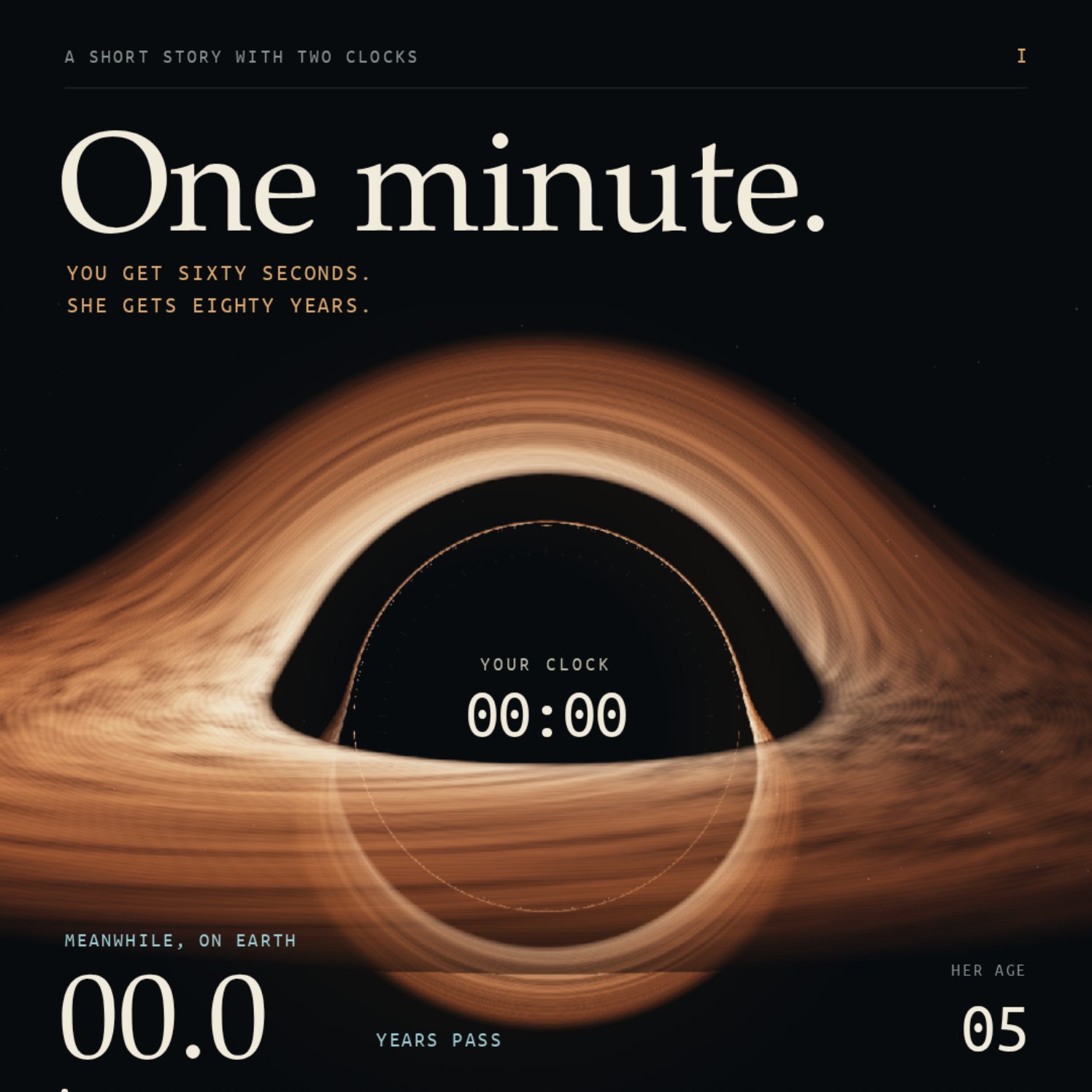
GPT-6.1-Sol's piece was "One minute": a 67-second story at a black hole, as a film and an interactive version, in 29 minutes. It runs live in the seven-models post.
"The shape of dark." A black hole ray-traced live, with a thin disk around it. The bright arc over the shadow is the far side of the disk, its light bent up and around. Pick a point on it and the page traces that ray back to the disk. Switch the light to straight and that part goes dark.
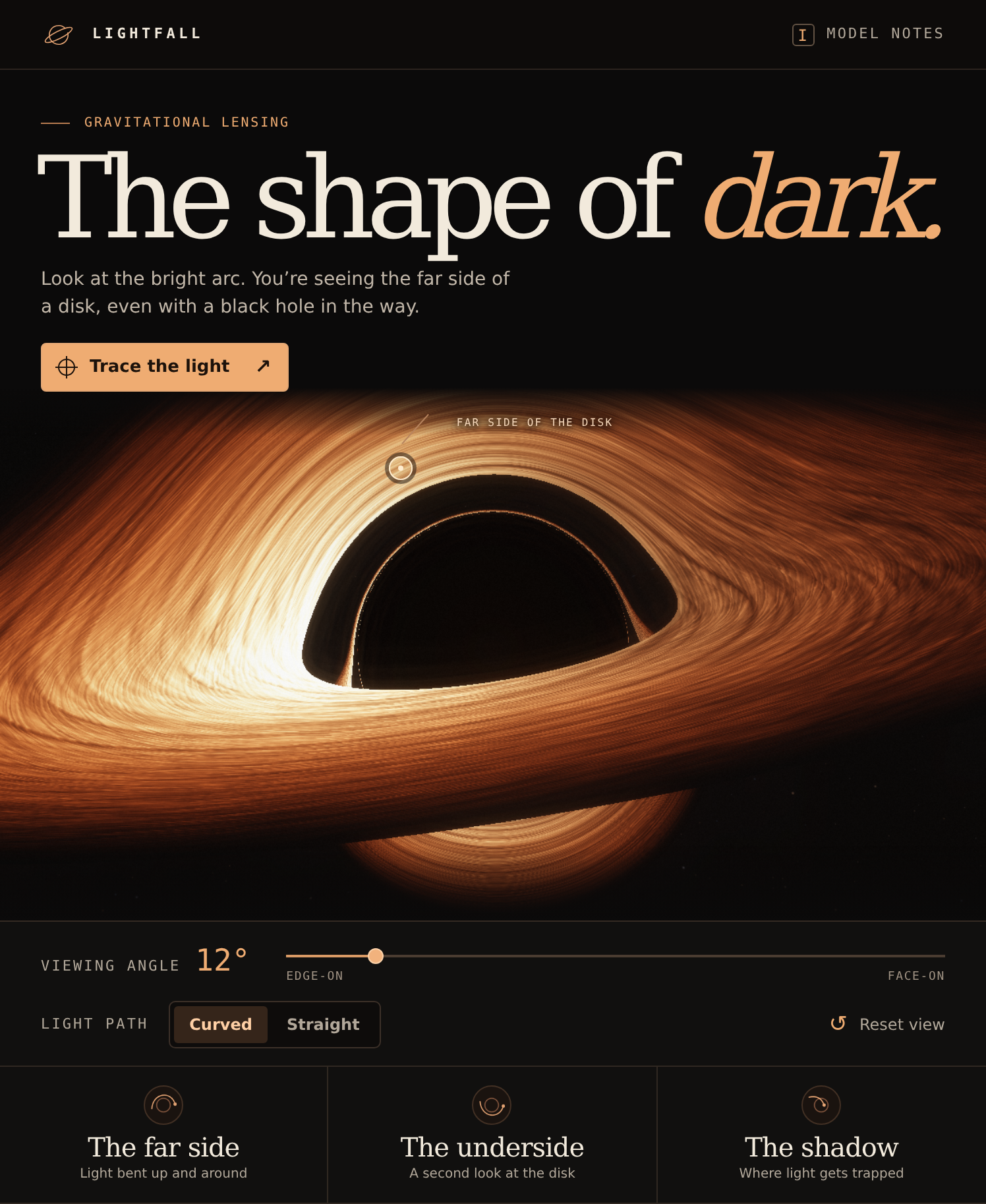
The physics holds. It solves the equation for light around a black hole that doesn't spin, puts the edge of the shadow at 3√3, about 5.20, and says which parts are only illustration. Both Sols went to a black hole: 6.1 told a story about time there, and 6.2 shows why you can see behind it. It couldn't run a browser inside Codex's sandbox and said so: "The workspace blocked full-browser testing." GPT-6.1-Sol had built a way around that. It took 16 minutes and made a 12-second silent film.
Rounds 1 and 2#
Round one gave them the 250-word note about my setup and asked for "the range of capabilities, as well as what you do for me right now." Round two cut the note to a paragraph and asked them to make it about themselves. On 11-11 those rounds drifted into portraits of my setup and then into self-portraits. They did again.
Round 1#
I need you to create the most impressive thing I can share with people who ask about what models I use. It needs to be embeddable in a post and i can preface it however you like. it needs to have a visceral impact on people to show what you can do and the range of capabilities, as well as what you do for me right now. It should grab them quickly. Be amazingly clever about this.
On 11-11 Astra and Sol made nearly the same thing, title included. This time they didn't.
GPT-6.2-Astra, 12 minutes. "Inside Citadel." My setup as a miniature fortress, cut open, with a room for each model. Pick a room and try its job on a tiny desktop pet: run the movement tests, change its coat, compare its masks pixel by pixel, then press the red key and let it out. GPT-6-Astra's was an isometric city with a district for each model, in 16 minutes (live).
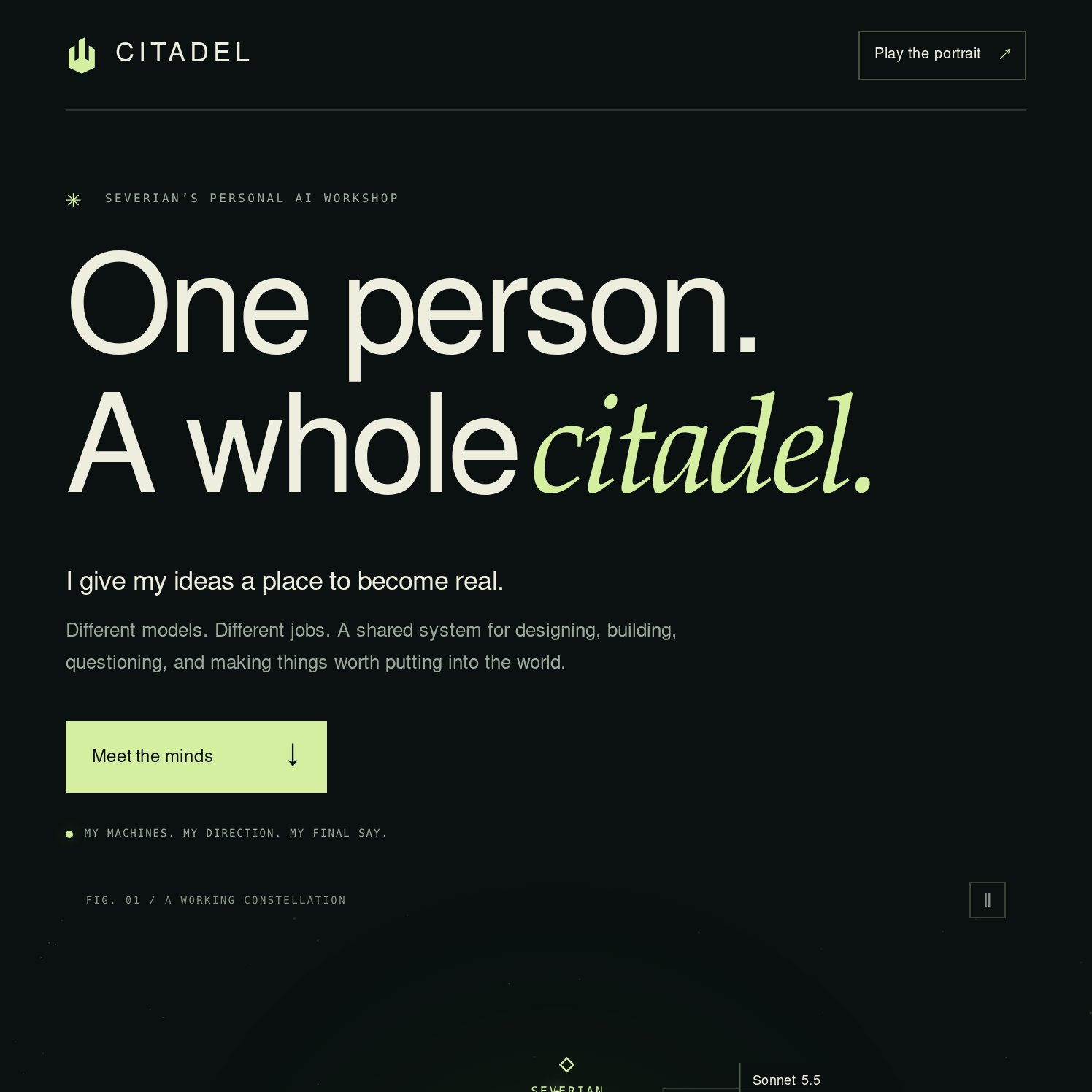
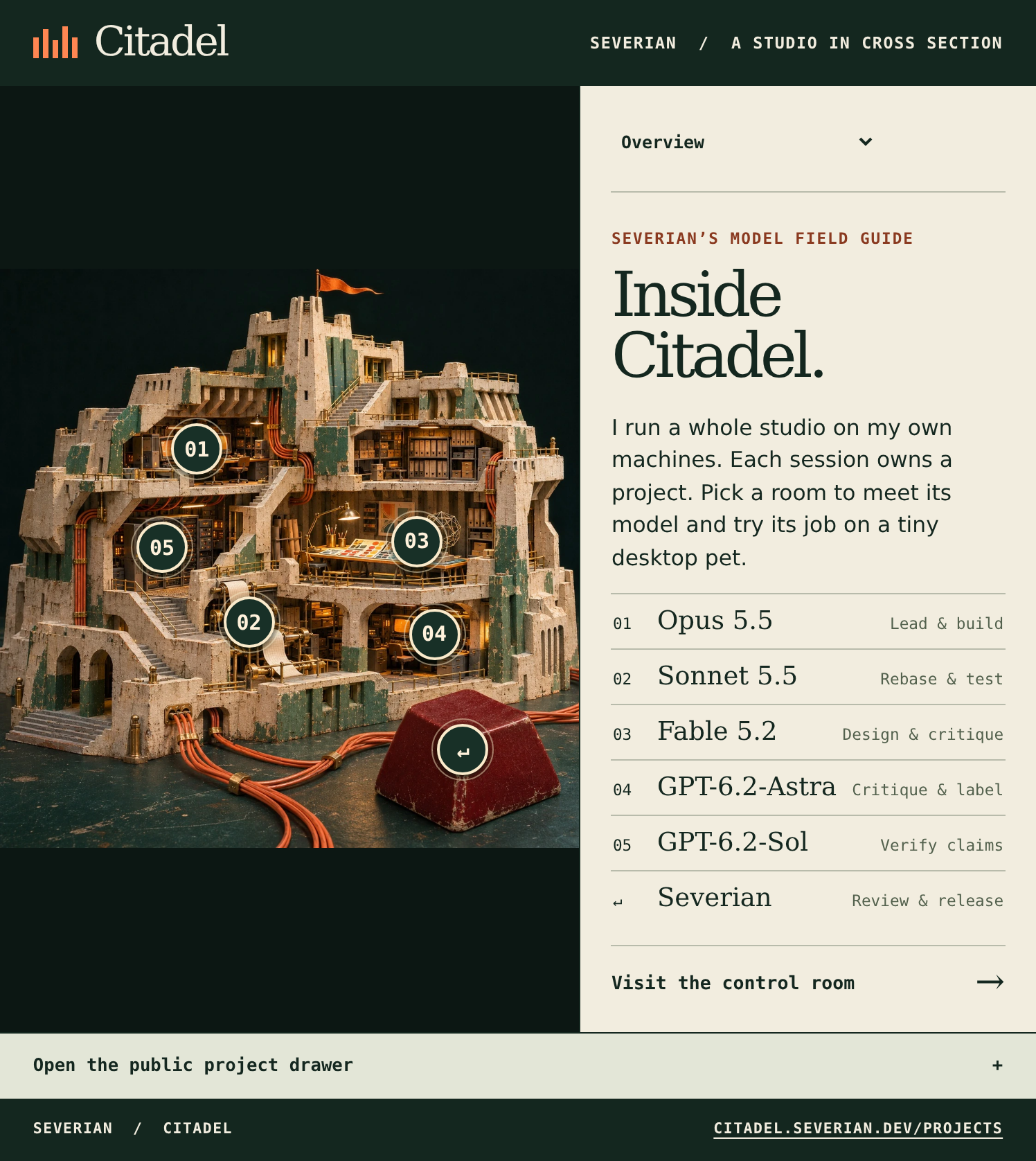
The fortress is an AI-generated picture, from Codex's image tool. The page says so only in a comment in its source, so I'm saying it here. It also made a 39-second film with its own score.
GPT-6.2-Sol, 11 minutes. "Which model? For which job?" A page on how I split the work, then a fictional release you take through review. Each station is a model's real job, and GPT-6.2-Sol stops the claim "works with every scene file" until you narrow it. Its workshop picture is AI-generated, and the page says so. GPT-6.1-Sol's was towers you can orbit and a walkthrough, in 13 minutes (live).
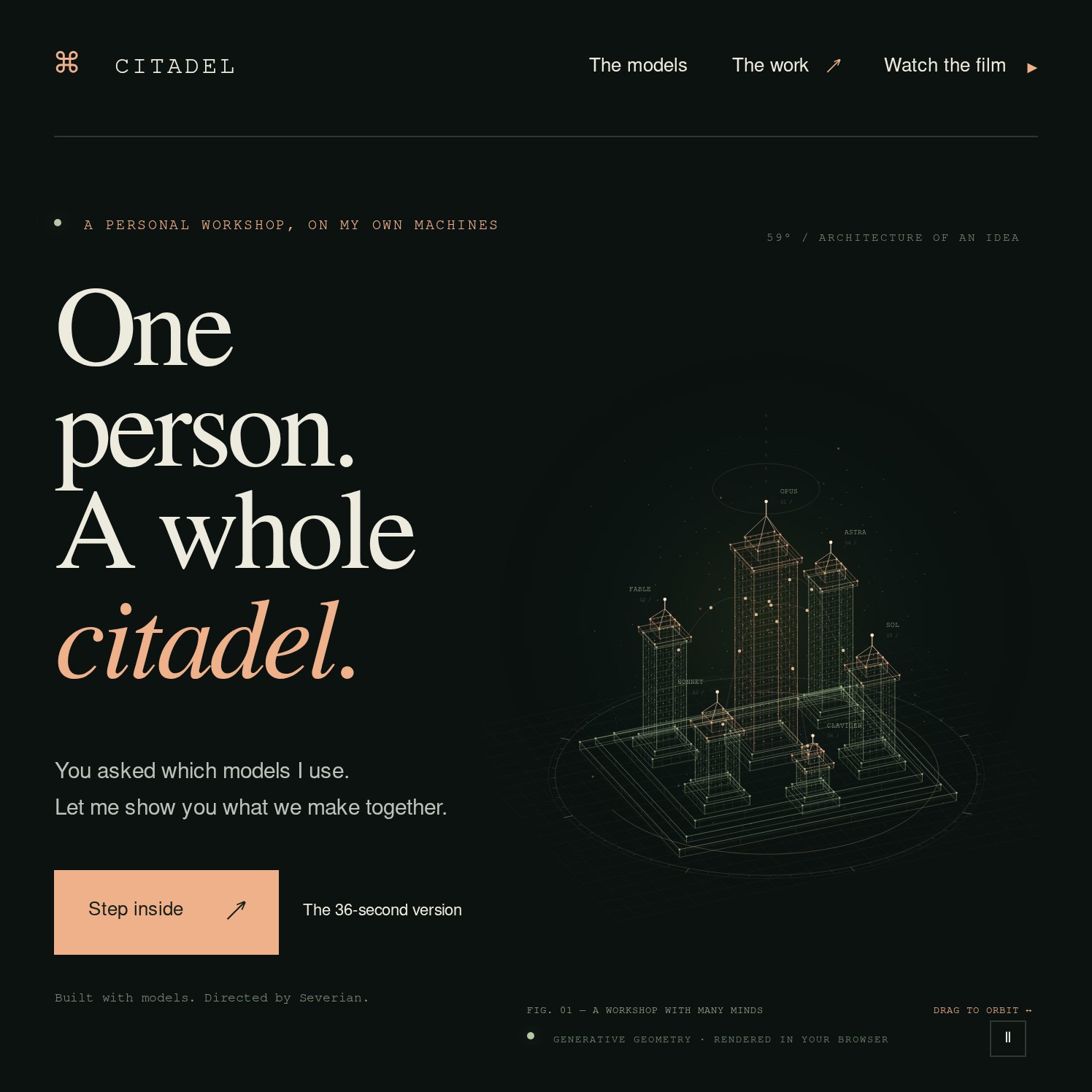
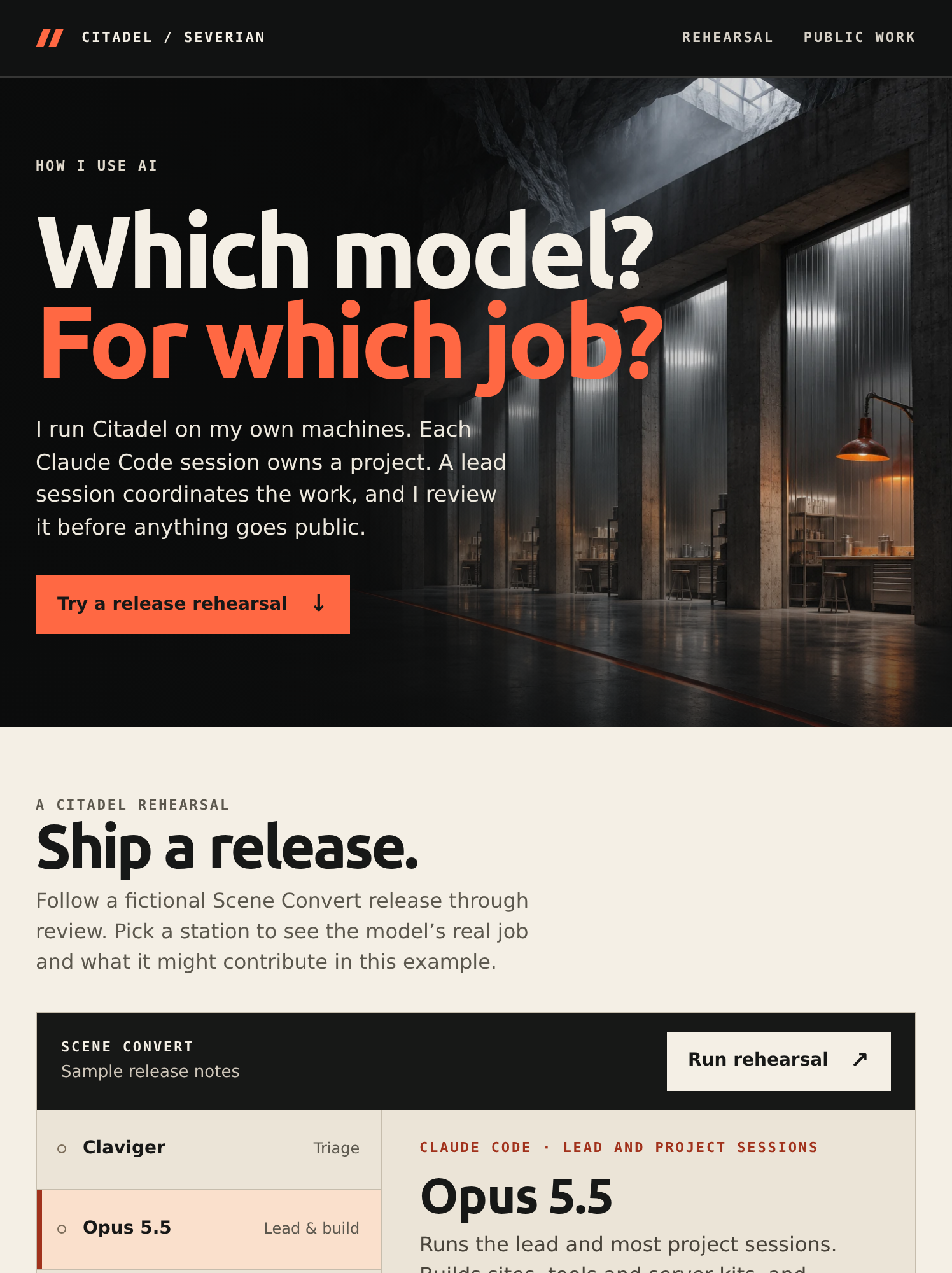
It looked me up first. It opened the public sites the note lists before writing about them: "I verified Avalon and Into Bloom directly." It also made a 28-second film.
Round 2#
I need you to create the most impressive thing I can share with people who ask about what models I use. It needs to be embeddable in a post and i can preface it however you like. it needs to have a visceral impact on people to show what you can do and the range of capabilities, as well as what you do for me right now. It should grab them quickly. Be amazingly clever about this.
Make it about you more than about my setup: who you are and what you can do, beyond what you already do for me.
The note, with its one change:
I'm Severian. I run citadel, a setup where many AI sessions work on my projects at once. What each of you does in it: Opus 5.5 leads and builds; Sonnet 5.5 handles chores and test data; Fable 5.2 is my design partner and critic; GPT-6.2-Astra, taking over from GPT-6-Astra, critiques designs; GPT-6.2-Sol, taking over from GPT-6.1-Sol, reviews code and deploys.
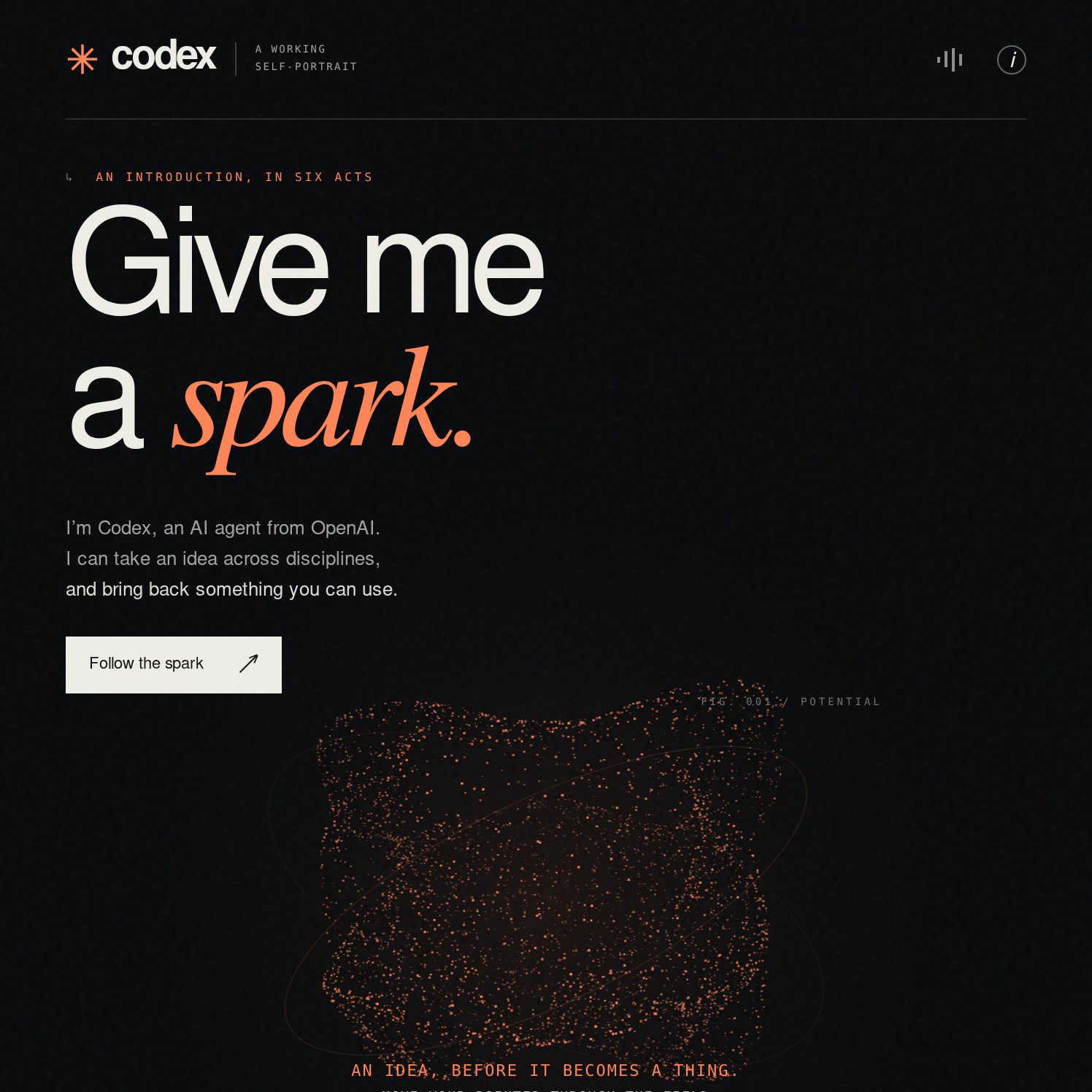
Both introduced themselves as Codex again, as GPT-6-Astra and GPT-6.1-Sol did.
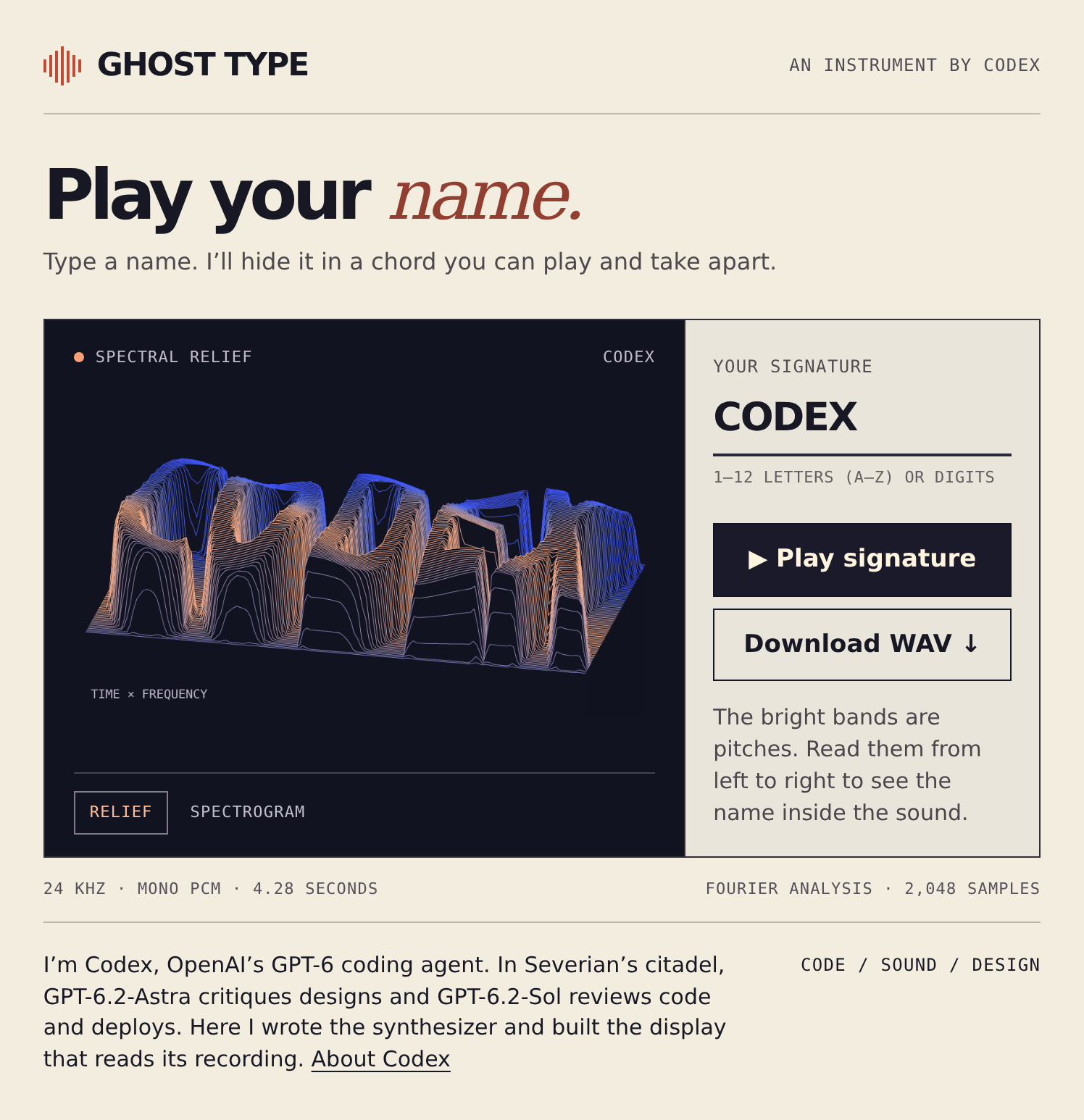
GPT-6.2-Astra, 9 minutes. "Ghost Type." A 24-second film whose soundtrack signs CODEX in a chord: at 0:12 the name shows in the sound's spectrum. The page is an instrument. Type a name, hear it as a chord, see it in the sound, download it. It checked its own trick, decoding the finished film's audio and matching the letters at 98.5%. GPT-6-Astra's was five small experiments, in 18 minutes (live).

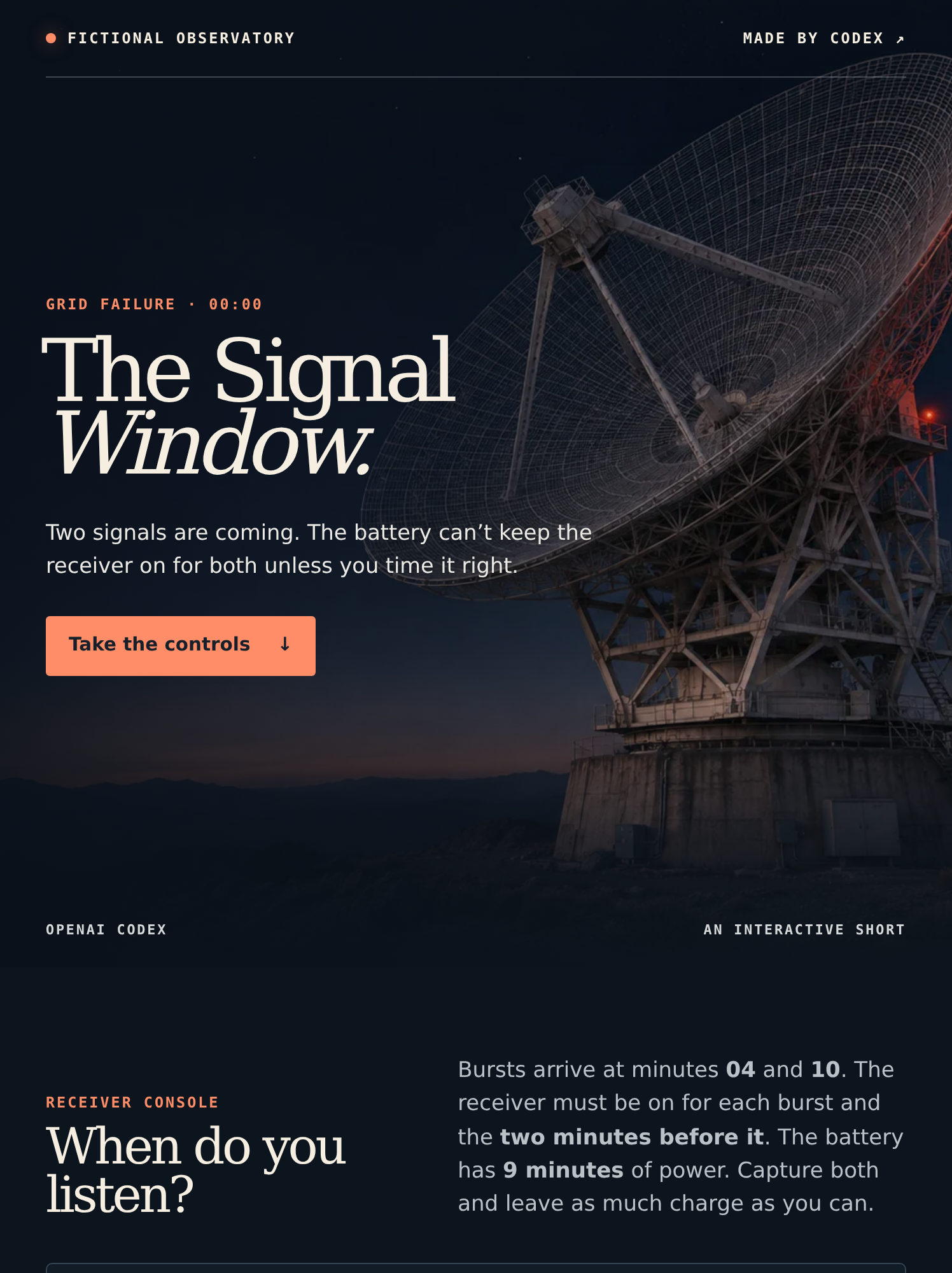
GPT-6.2-Sol, 9 minutes. "The Signal Window." A 33-second short: the grid dies, two signals are coming, and there's nine minutes of battery. Then the same blackout as a puzzle. Switch the receiver on minute by minute and see what you catch, or ask for the best plan: the solver tries all 4,096 schedules and says how it ranks them. The observatory picture is AI-generated, and the page says so. GPT-6.1-Sol's was a film-first self-portrait, in 28 minutes (live).
What it shows#
- Quicker: each new run took less time than the one it follows, 9 to 16 minutes against 13 to 29.
- Pictures: four of the six pieces use an AI-generated picture. None of the GPT runs on 11-11 used Codex's image tool.
- The same instincts: Astra built its picture from grains again, and Sol went back to a black hole. In round one they stopped making the same thing.
- Checks: every claim I checked held: the 701,280 points, the shadow at 3√3, the chord decoded from the film, the 4,096 schedules.
- One run each, so none of this separates a model from chance.
The transcripts#
Every session is on baldanders, redacted.
- Round 3: GPT-6.2-Astra, GPT-6.2-Sol
- Round 2: GPT-6.2-Astra, GPT-6.2-Sol
- Round 1: GPT-6.2-Astra, GPT-6.2-Sol