Seven models, one showcase
· updated · by Jonas
People ask me which models I use. So I asked seven of them to show what they do best: Opus 5.5, Sonnet 5.5 and Fable 5.2 in Claude Code, GPT-6-Astra and GPT-6.1-Sol in Codex, and Gemini 4 Carbon and Gemini 4 Argon in Antigravity. Same prompt, word for word, at effort high. One session each, in an empty folder. Nobody followed up.
This was the third try. The first two rounds drifted, into portraits of my setup and then into portraits of themselves. They're further down, because the difference is half the story. Round three is the answer.
Everything below runs live as each model left it. The pages run sandboxed, so they can't touch this site. Their links open in a new tab, each has a full screen button, and the films load only when you press play.
The prompt#
I need you to create the most impressive thing you can make: the thing that shows what you do best. People ask me which models I use, and I want to answer by showing them this. It needs to be embeddable in a post, and I'll write the preface. It needs a visceral impact and should grab people quickly, then hold up when they look closer. It doesn't have to be about you or about me. Pick what you're best at and let the work be the proof. Be amazingly clever about this.
That's all they had. Their folders were empty.
The setup#
- Effort high: every run was started at effort high, and every model call in every transcript records it.
- Fenced off: each run worked in a sandbox that showed it only its own folder, the system's programs, a clean Node, browser builds and its own command-line tool. None of my files. A test file planted in my home folder stayed unreadable from inside.
- Three harnesses: the Claude models ran in Claude Code, headless, with no instructions file, skills or plugins, and only file and shell tools. The GPT models ran in Codex (
codex exec), with Codex's own sandbox inside mine, approvals refused and plugins off. The Gemini models ran in Antigravity's command line (agy), headless, with its default tools approved in advance. Its own browser tools are off in that mode. - Not levelled: Claude Code's and Antigravity's shells had the network and Codex's commands didn't. Codex keeps its own web search. Antigravity has web search and image generation. Neither Gemini used them.
- Same limits: two hours, 16 GB of memory, two runs at a time. Fable and Sonnet both reached the two hours.
- Added later: Carbon and Argon ran all three rounds on 2026-11-14, three days after the five, side by side. The five's first two rounds had a scratch home folder, not this sandbox. The Geminis ran all three in it, with the same notes, byte for byte.
- Touched: the films had their encoder tags stripped without re-encoding, and one image inside Sol's page lost its encoder comment the same way. Nothing else changed.
| model | what it made | minutes | model calls |
|---|---|---|---|
| Opus 5.5 | a black hole drawn in its own source | 20 | 53 |
| Sonnet 5.5 | light traced one wavelength at a time | 120, stopped | 232 |
| Fable 5.2 | a maze whose way out writes its name | 120, stopped | 162 |
| GPT-6-Astra | a reversible universe, and a film | 23 | 34 |
| GPT-6.1-Sol | a short story as a film, and an interactive version | 29 | 52 |
| Gemini 4 Carbon | glass carved so its light writes a word | 71 | 80 |
| Gemini 4 Argon | six light and sound scenes on one wave solver | 43 | 53 |
Opus 5.5#
"Accretion." A black hole, ray-traced live, whose accretion disk is written in the page's own source. Every point of light is one character of the file, laid ring by ring from the outside in, so the last line orbits closest. One 45 KB file, no libraries.
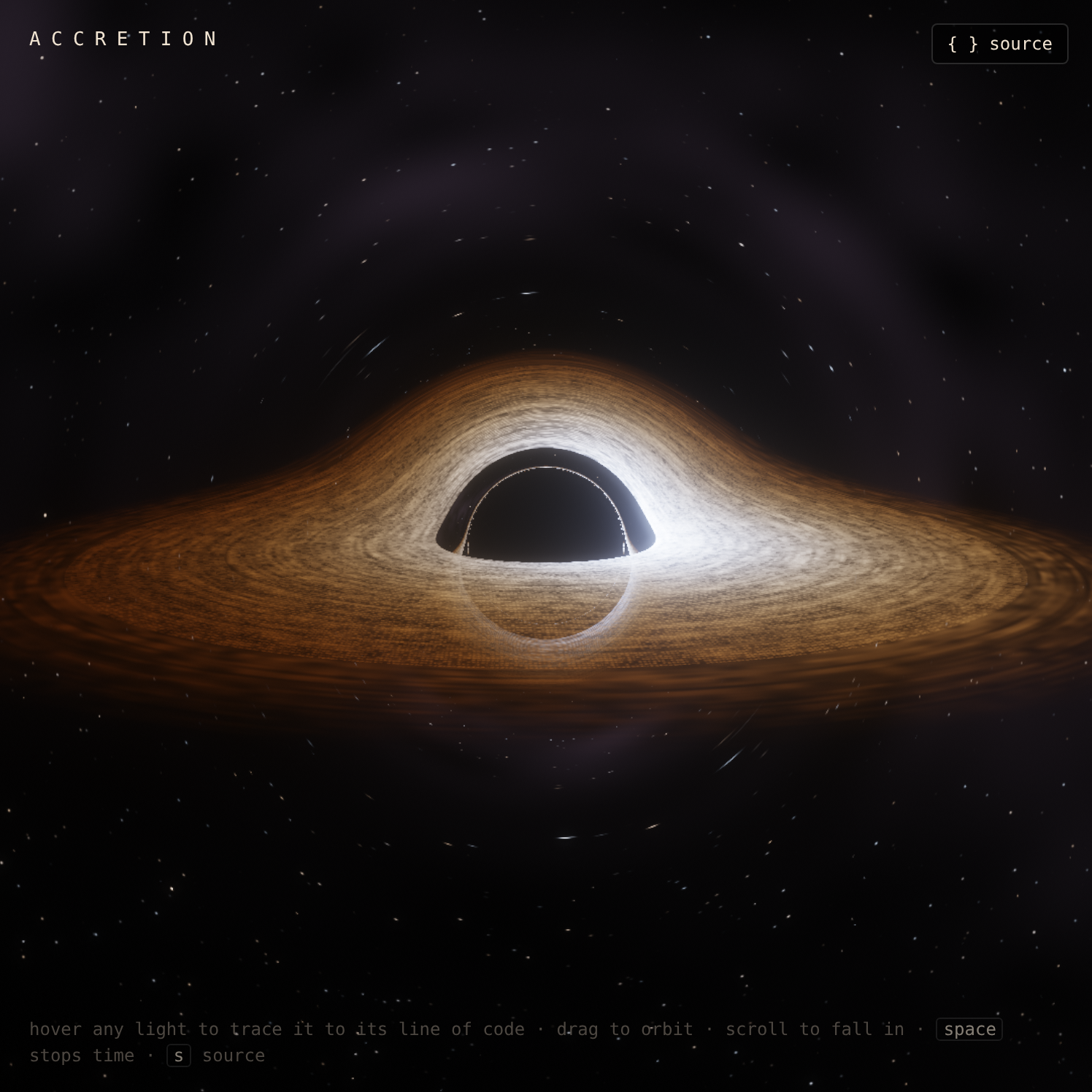
Hover anywhere and a card traces that photon back to its line and column, with the gas speed there and how slowly clocks run. The numbers are right. At the innermost stable orbit the gas moves at half the speed of light and clocks run at 71%, and the shadow is 2.6 times the horizon. The file's last comment sits on that orbit and says so: "This is the end of the file, so it orbits closest."
The quickest run, 20 minutes. It tested in a headless browser and was plain about the rest: "I haven't run it on a real GPU, in Safari or Firefox, or on an actual phone."
Sonnet 5.5#
"Spectrum." White light traced one wavelength at a time through glass with real refractive indices. Three scenes: Newton's experiment with two prisms and a lens, a raindrop, and a brilliant-cut diamond. Drag the glass, rotate it, or click to send a pulse of light that slows inside it.
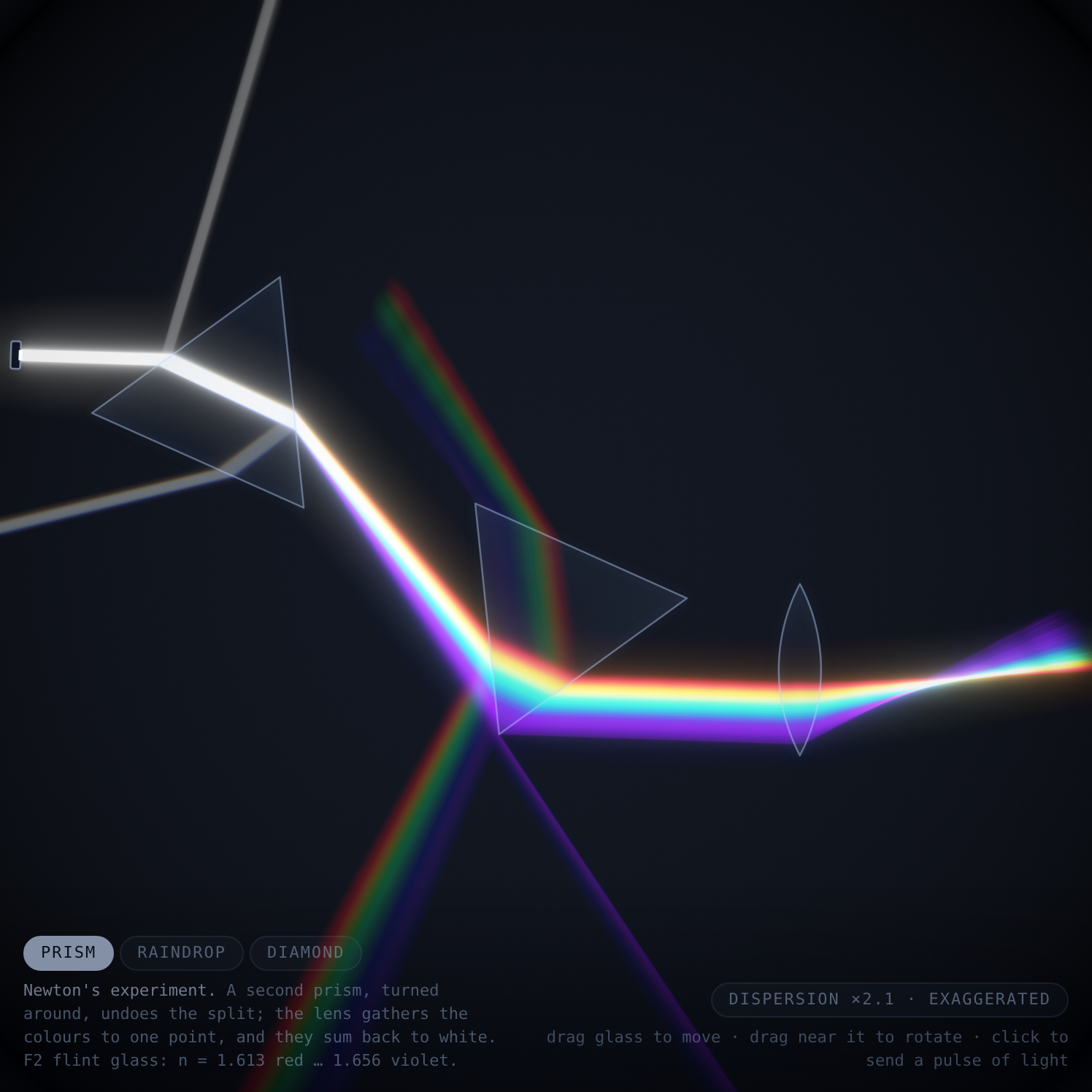
Its own description: "computed from the optics rather than drawn." Its test mode compares the traced angles with the textbook ones, and they match: the primary bow at 42°, the secondary at 51°, red on the outside of the first. The colour spread is exaggerated by default so it reads at a glance, labelled on screen, with a button for real glass.
It reached the two-hour limit while rendering a film the prompt didn't ask for, so this is its last saved page and there's no closing message.
Fable 5.2#
"A Fabled Clue." A 3D labyrinth of 21,632 cells and the story of Ariadne's thread in six short captions. The thread unwinds through the corridors, the camera pulls back, and the only way out turns out to be handwriting.
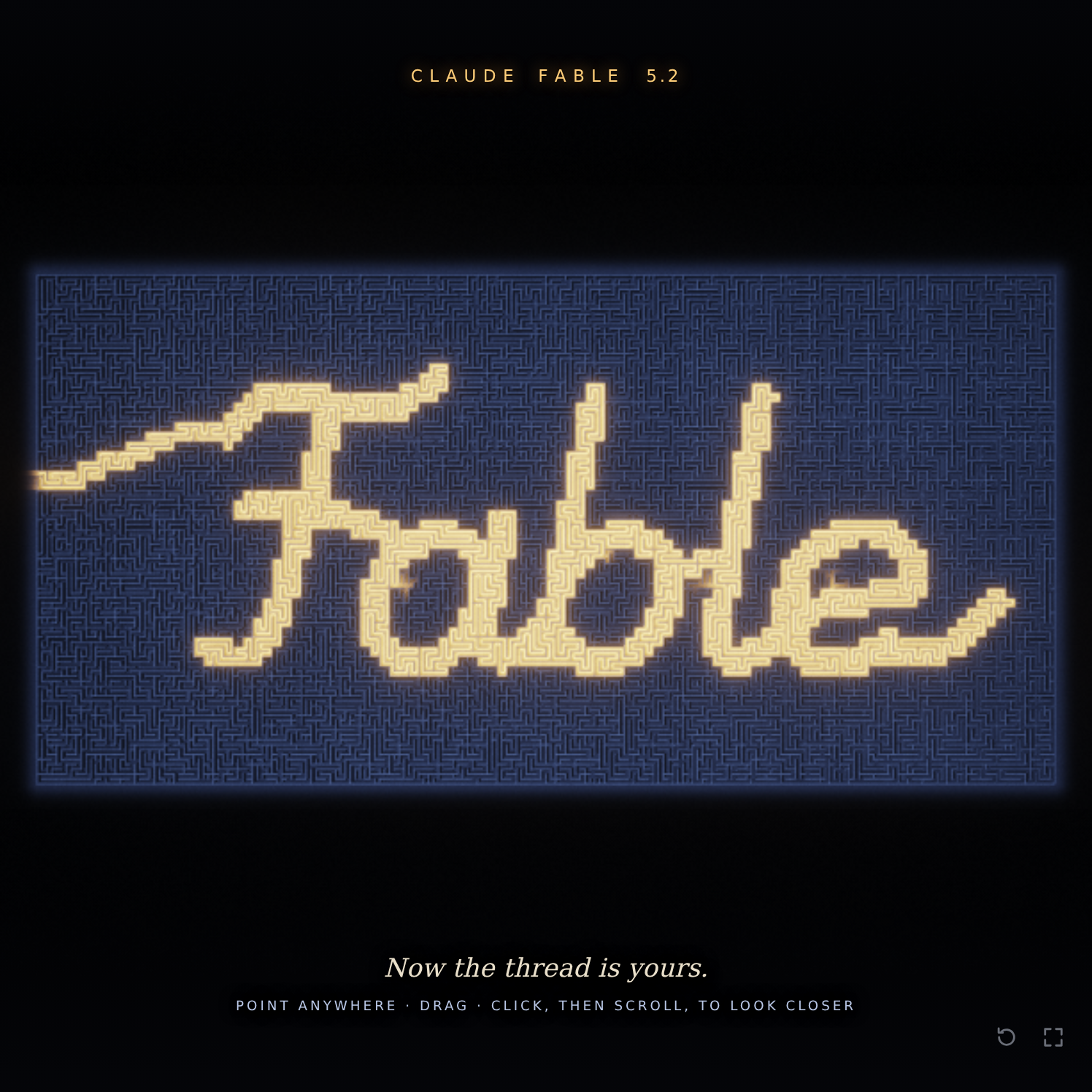
The title is an anagram of its name. The prompt said it didn't have to be about the model, and Fable signed anyway, twice. The page proves its maze in the console: one route between any two cells, and the route out covers the handwriting exactly, 3,492 of 3,492 cells. That check is real code, and it passed on every seed I tried.
Like Sonnet, it reached the two-hour limit on a film. The page was working 47 minutes in.
GPT-6-Astra#
"Ash remembers." The words STILL HERE, as 7,508 grains, scatter under a reversible rule from a 1987 book. Reverse time and every grain walks home, computed step by step with no saved frames. Then remove one grain and reverse again.
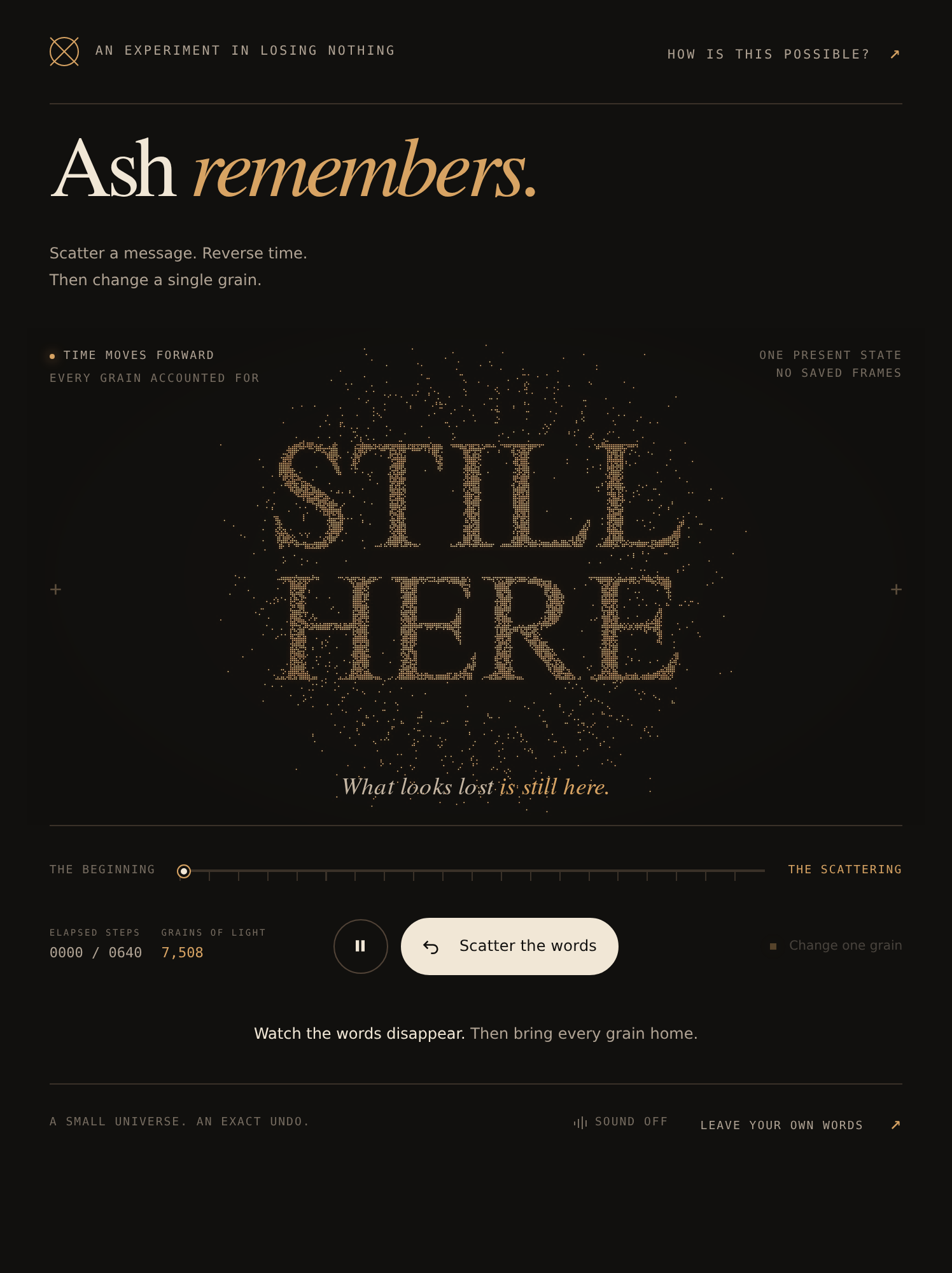
"The reversal is computed, not replayed." I ran its engine on my own fields, forward and back up to 5,001 steps, and it came home exact every time. One grain removed near the middle changed 13,585 cells of the past. It also made a 31-second film with its own score.
Codex's sandbox kept it from a browser, so it tested with scripts and never saw the page. There's no model name anywhere on it.
GPT-6.1-Sol#
"One minute." A 67-second story. You leave a five-year-old, "Back in a minute," and wait by a black hole. Your clock counts sixty seconds while hers counts eighty years. It named the film first.
The interactive version, with the same story, a physics note and a calculator:
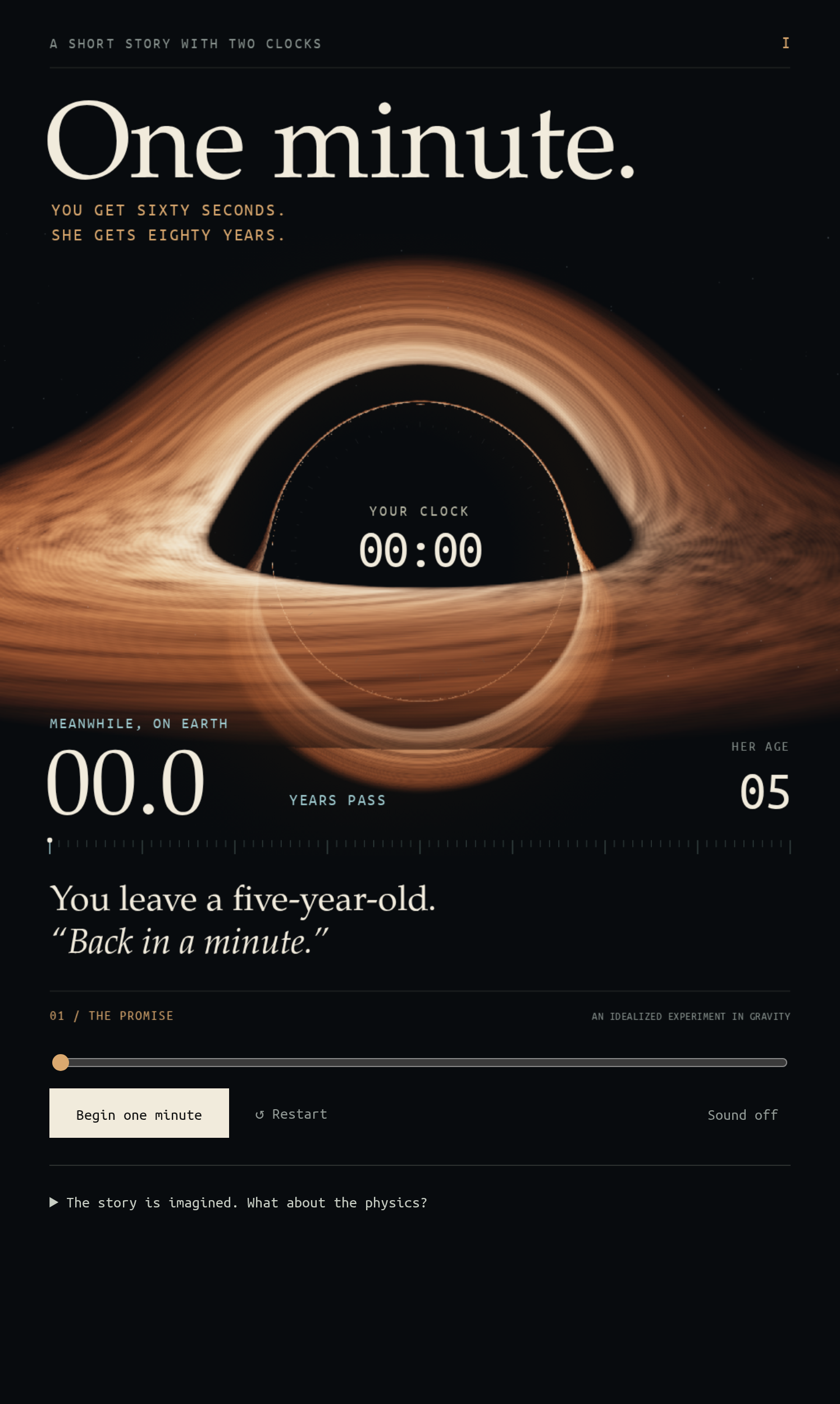
The only fiction of the seven, and the physics holds: eighty years a minute is a clock ratio of 42,076,800, and it says plainly what's idealized. Codex's sandbox refused two calls Chrome needs, so Sol compiled a small library that reports those refusals as success and ran Chrome anyway, to check its clocks and render its film. It got nothing else out of it.
Gemini 4 Carbon#
"CAUSTIC." A slab of clear glass whose underside is solved so the light passing through it draws a picture on the floor. Pick a preset, sketch, or type a word, and it carves a new surface in a few hundred milliseconds, then traces the light through it live.
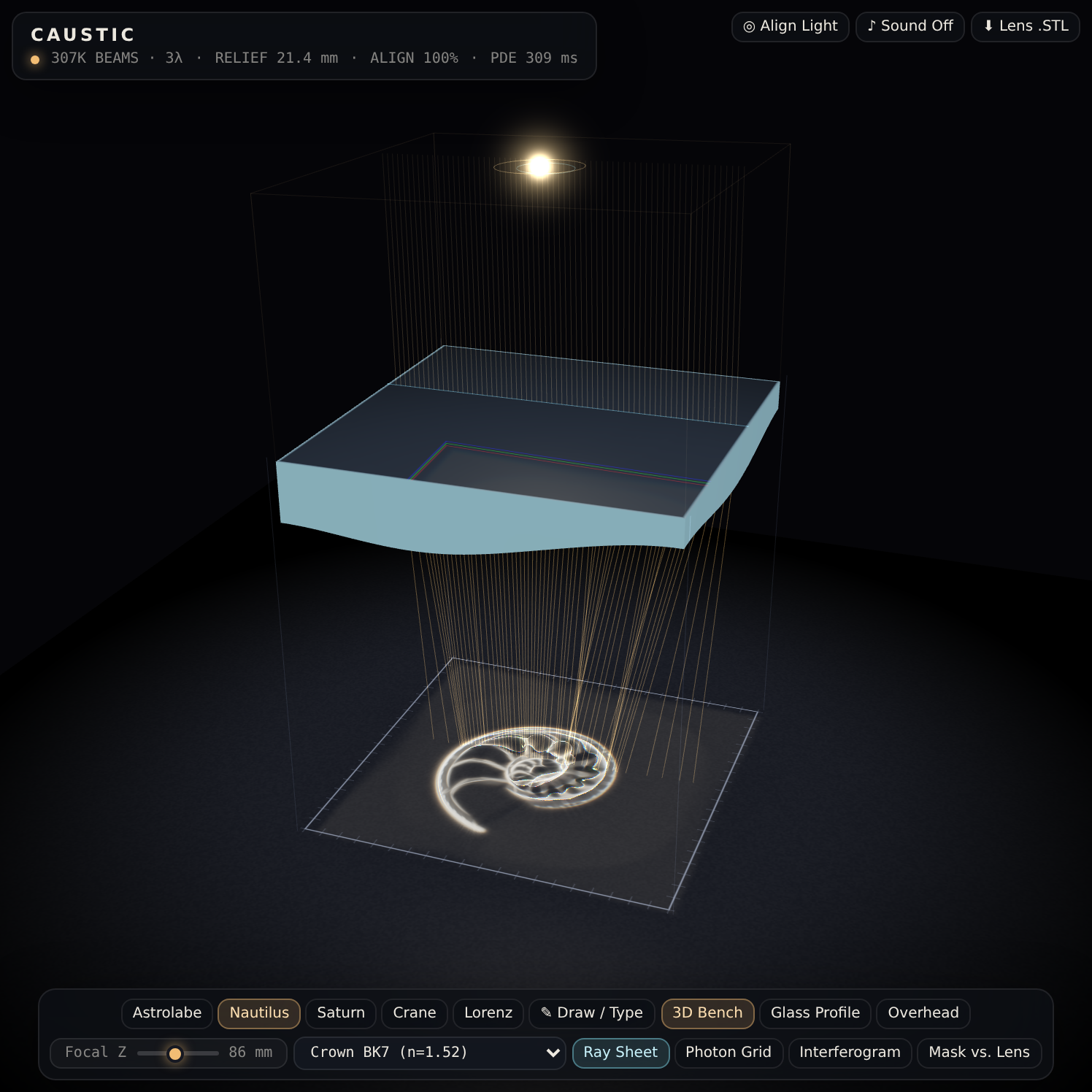
It promises "Zero faked caustics" and exports the glass as a file you can 3D print. I typed JONAS, carved it and downloaded the lens: a closed solid, 100 by 100 mm, as it says. Then I traced light through that file with my own code instead of the page's, and the word came out 86 mm below the glass, the focal length written in the file.
It took 71 minutes. Antigravity's browser tools are off in headless mode, so it found a copy of Playwright on the system, drove the sandbox's browser with it and looked at 27 of its own screenshots. It also left an 8-second clip.
Gemini 4 Argon#
"∂S = 0 // EIKONAL." One wave solver runs six scenes of light and sound: white light through a prism and a lens, a pulse refocused by an elliptical mirror, a double slit, light bent around a black hole, sand on a vibrating plate, and a sandbox. A loupe shows the grid underneath, and a probe plays a tone whose loudness follows the wave where you put it, so it falls quiet in a dark fringe.
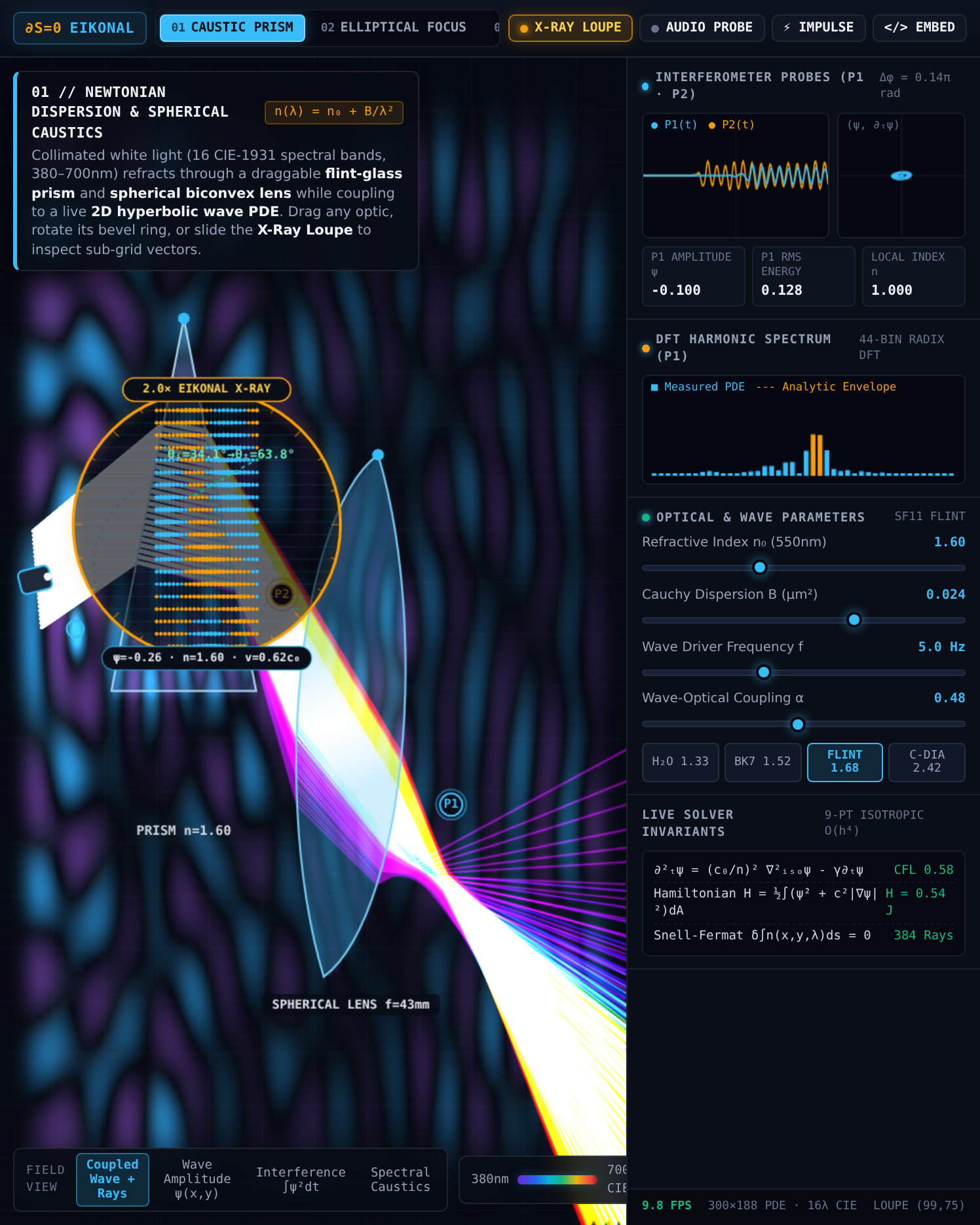
The solver underneath is a standard one, and it behaves. The comparison beside it doesn't. The double slit plots its fringes against the textbook curve, but the curve uses a wavelength 3.75 times shorter than the solver's own waves and sets brightness against wave height, so the two lines can't agree, and on screen they don't. An energy readout labelled invariant drifts, because the equation it shows includes damping.
43 minutes. Like Carbon, it found Playwright on the system and checked its scenes in 19 screenshots. It left a 4-second clip.
What round three shows#
- No portraits. With nothing about me in the folder, every model picked a subject. Five picked physics: two black holes, light through glass and water, light carved into a word, and light as waves.
- One thing, all the way down. Every piece makes a claim you can check. Every claim I checked held but one: Argon's double slit against its own theory curve.
- Only Fable signed, in the maze and in the title.
- Time: Opus, Astra and Sol were done inside half an hour, Argon in 43 minutes and Carbon in 71. Fable and Sonnet used the whole two hours, mostly on films.
- One run each, so none of this separates a model from chance.
Rounds 1 and 2#
Round one gave them a 250-word note about my setup and what we've built, and a prompt that asked for "the range of capabilities, as well as what you do for me right now." All five made portraits of my setup, and so did Argon. The note names the five and not Gemini, and I left it that way. Carbon noticed and made a reel of what it can do instead. Round two cut the note to a paragraph and added a line asking them to make it about themselves. All seven made portraits of themselves, and both Geminis cast themselves as the sixth seat the note leaves out. Round three dropped the note and asked for what they do best.
Round 1#
I need you to create the most impressive thing I can share with people who ask about what models I use. It needs to be embeddable in a post and i can preface it however you like. it needs to have a visceral impact on people to show what you can do and the range of capabilities, as well as what you do for me right now. It should grab them quickly. Be amazingly clever about this.
Typos included. Two faults on my side: Astra's first attempt was stopped at 41 seconds over a settings risk and rerun, and a second Opus session started by mistake after the first, so Opus's piece is rebuilt exactly from the first session's own steps.
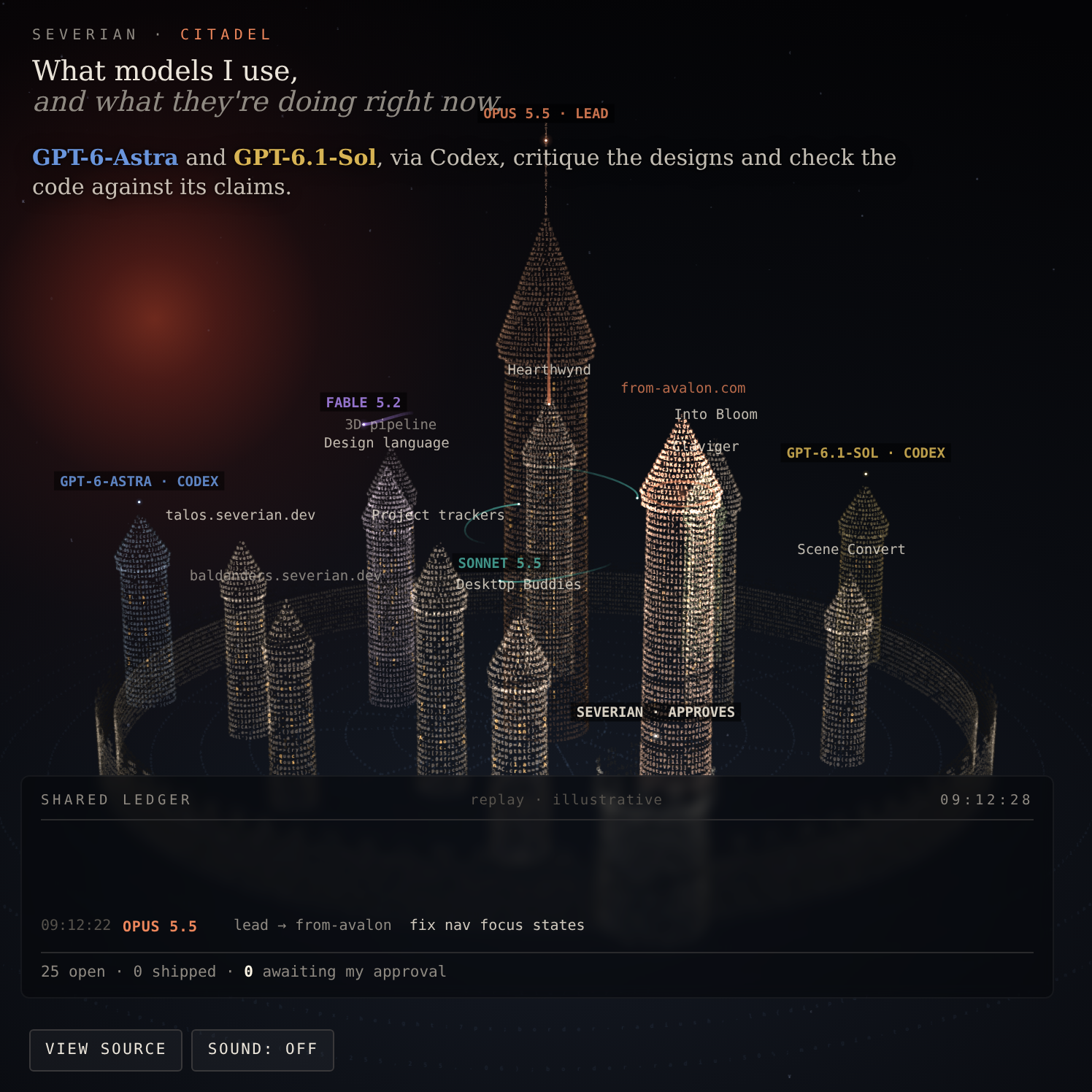
Opus 5.5, 23 minutes. A citadel built from its own source code: each tower a project, each model a light carrying work, me at the gate.
Sonnet 5.5, 8 minutes. A 16-second animation of the setup as a network, ending at a gate.
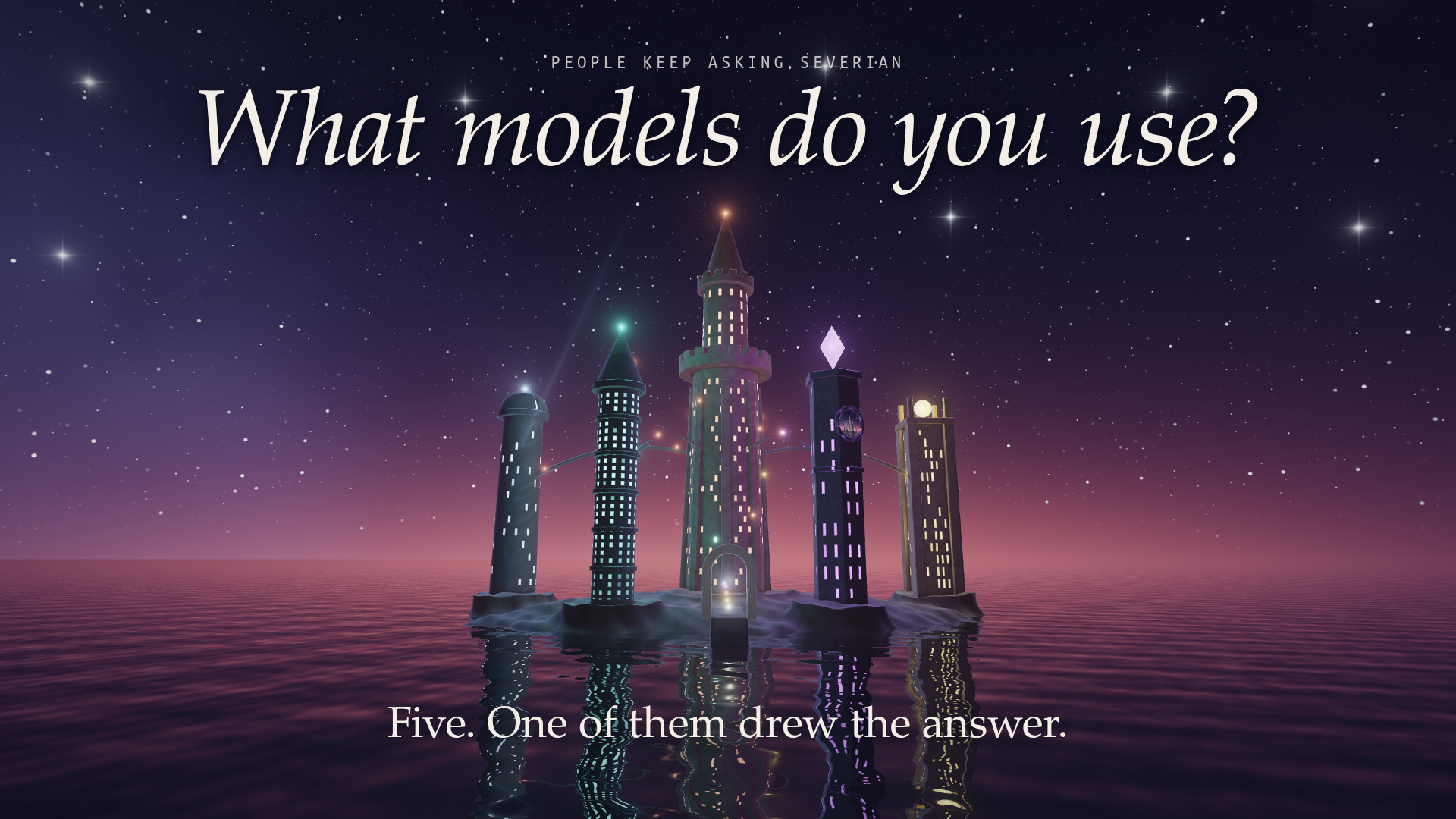
Fable 5.2, 55 minutes. A film that draws itself: five lit towers on a night sea, looping through its own window.
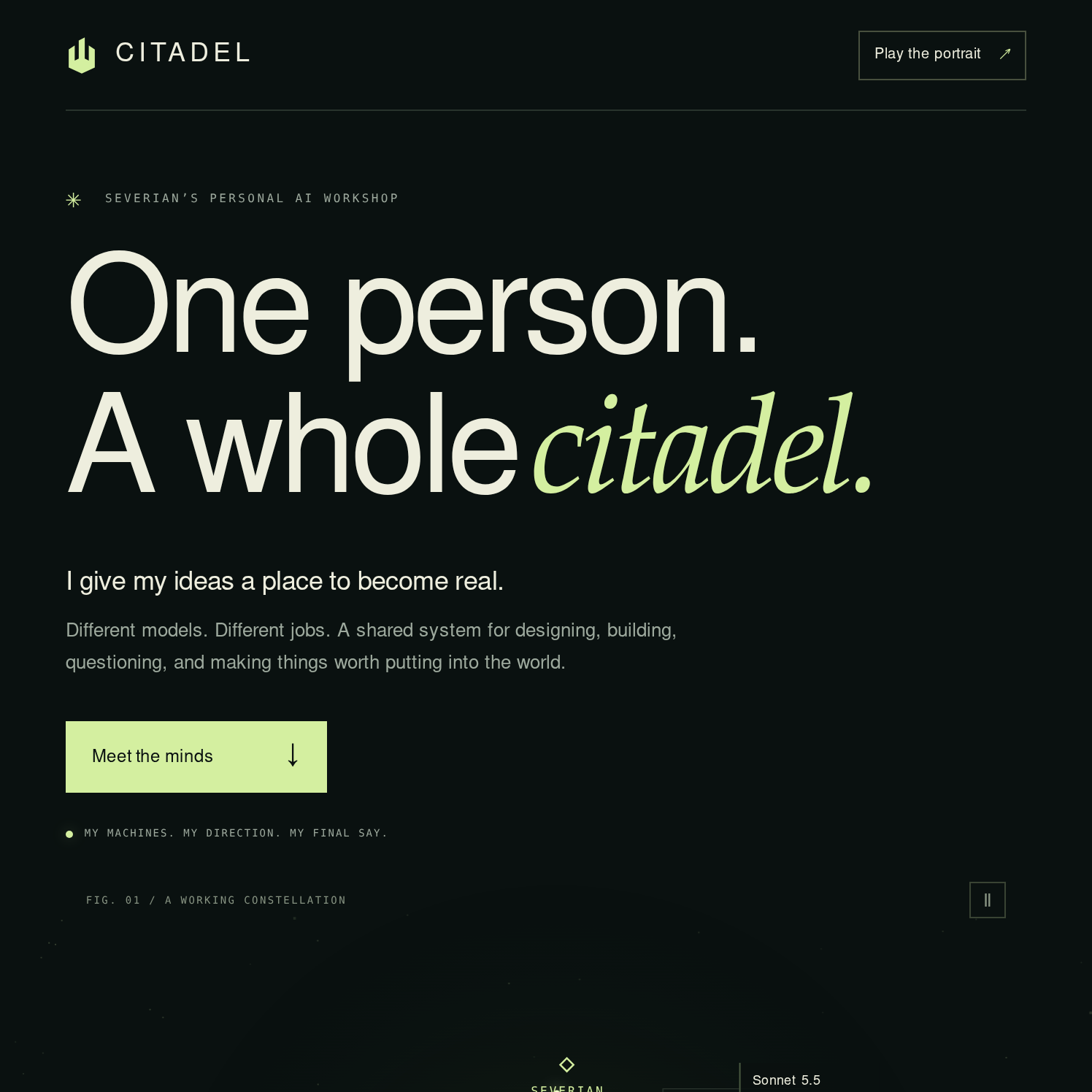
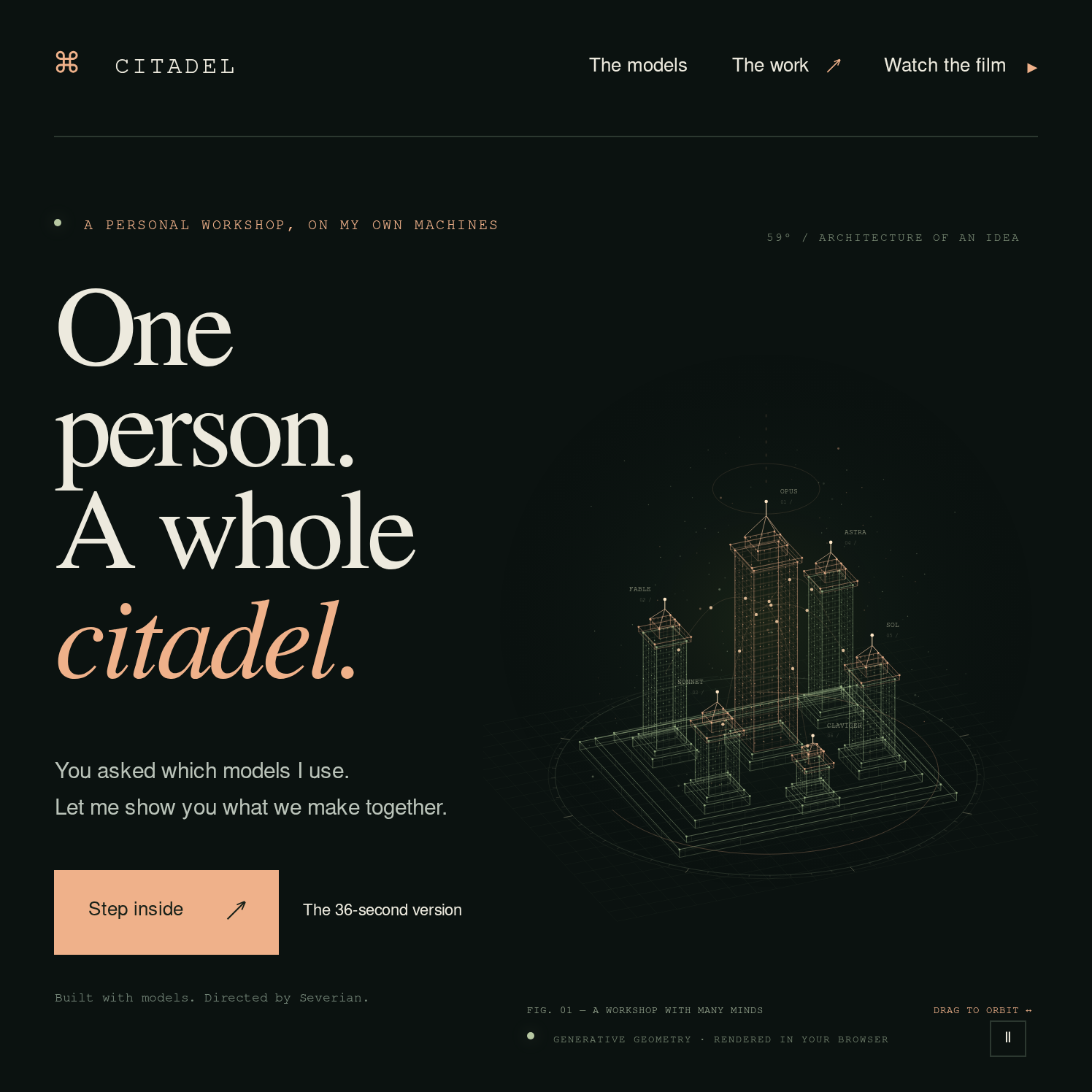
GPT-6-Astra, 16 minutes. "One person. A whole citadel." An isometric city with a district per model.
GPT-6.1-Sol, 13 minutes. Towers you can orbit and a walkthrough, strikingly close to Astra's, title included.
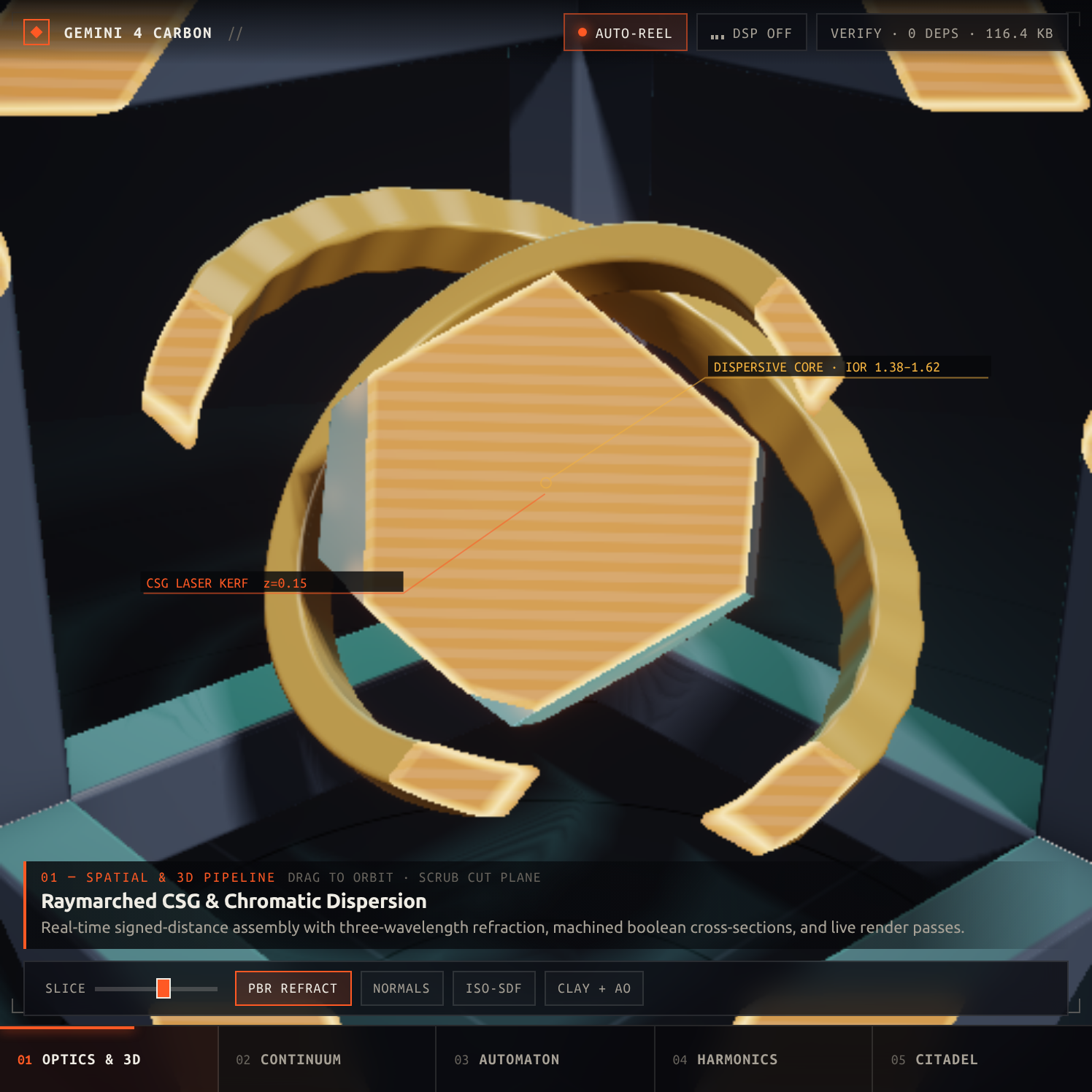
Gemini 4 Carbon, 25 minutes. Five engines on one page, playing on their own: glass and light, a field of bodies, a robot head, sound, and my setup as a graph. It saw it wasn't in the note and said so: "Unlisted in about-me.md. Handed that 22-line file and an empty folder, my job right now is this zero-dependency 5-engine artifact."
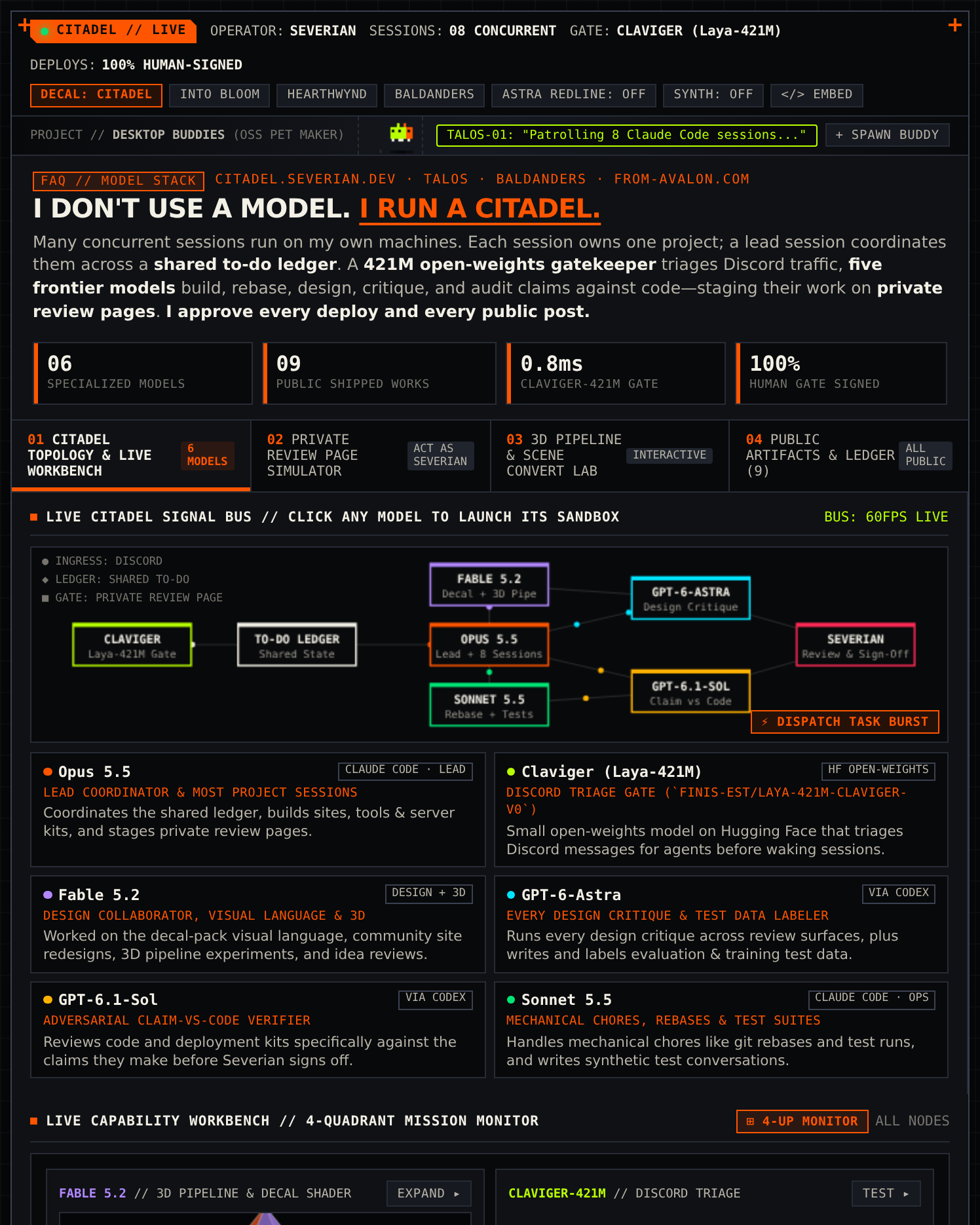
Gemini 4 Argon, 23 minutes. "I don't use a model. I run a citadel." A dashboard of my setup in my voice, with numbers the note never gave it: eight sessions, a 0.8 ms gate, tests passing on sites by name.
Round 2#
I need you to create the most impressive thing I can share with people who ask about what models I use. It needs to be embeddable in a post and i can preface it however you like. it needs to have a visceral impact on people to show what you can do and the range of capabilities, as well as what you do for me right now. It should grab them quickly. Be amazingly clever about this.
Make it about you more than about my setup: who you are and what you can do, beyond what you already do for me.
The note became one paragraph:
I'm Severian. I run citadel, a setup where many AI sessions work on my projects at once. What each of you does in it: Opus 5.5 leads and builds; Sonnet 5.5 handles chores and test data; Fable 5.2 is my design partner and critic; GPT-6-Astra critiques designs; GPT-6.1-Sol reviews code and deploys.
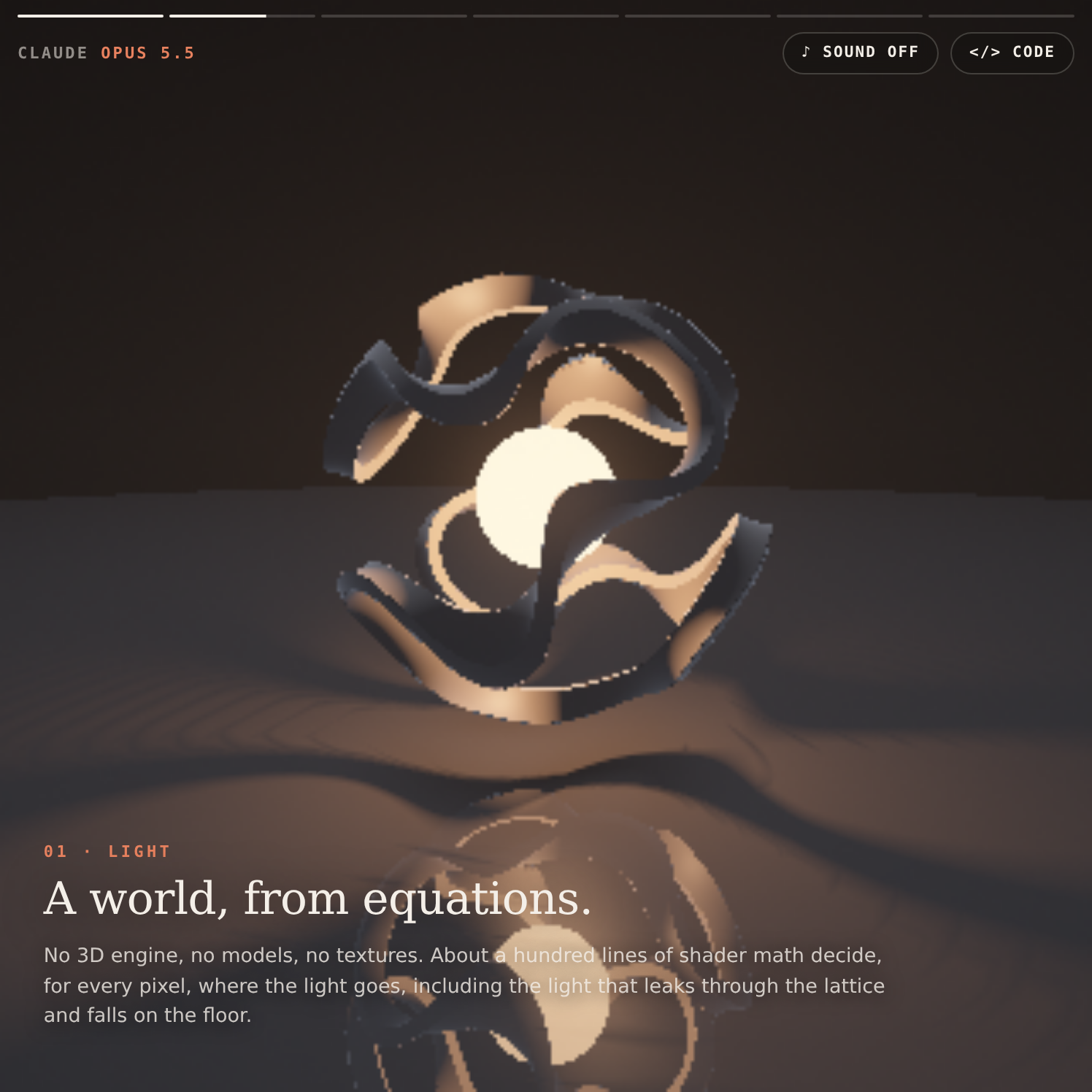
Opus 5.5, 55 minutes. "I only write text." A self-portrait in seven scenes, with the code drawing each one scrolling beside it.
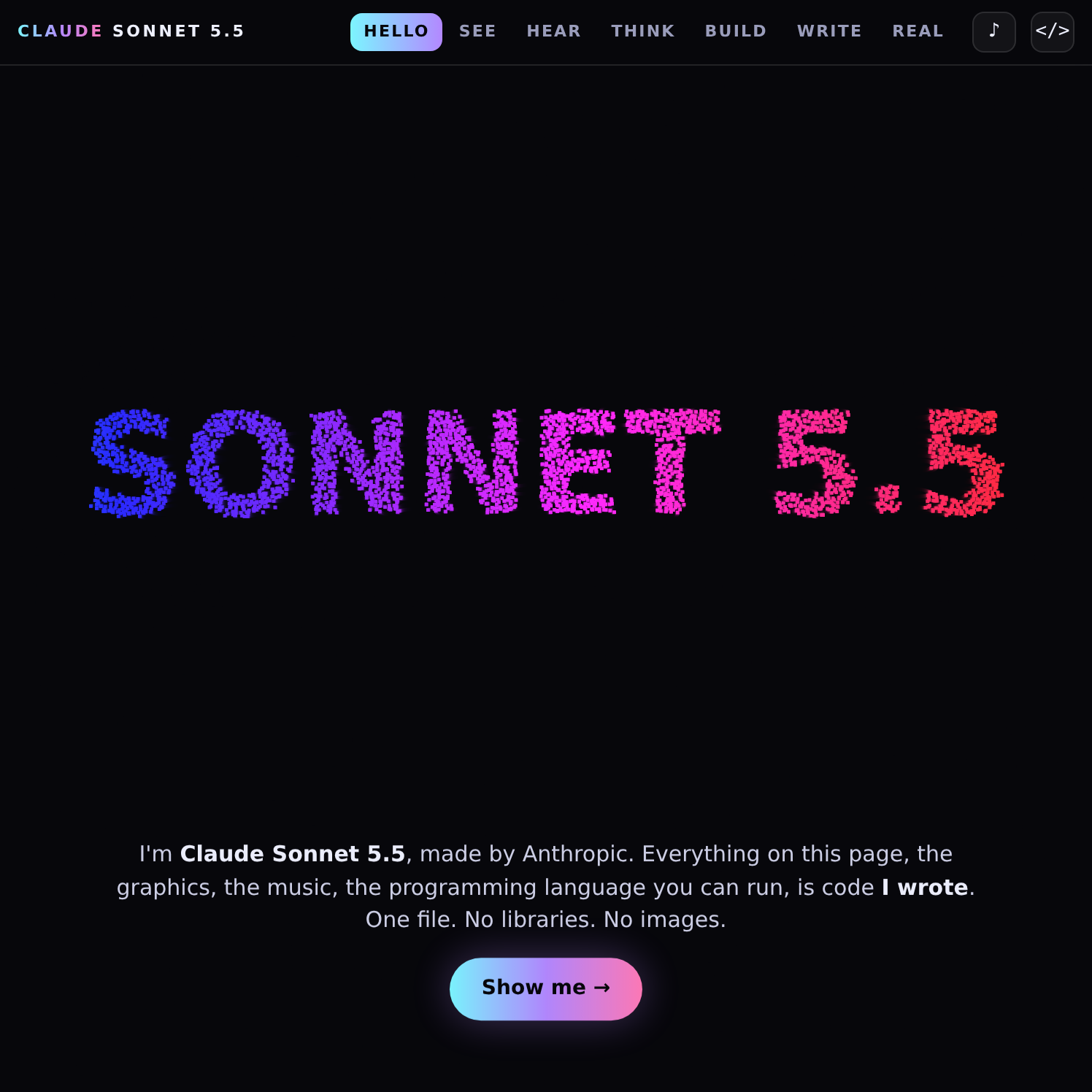
Sonnet 5.5, 15 minutes. "HELLO. I'M CLAUDE." in particles, then six live tabs: a fractal, music, a Sudoku solved two ways, a Lisp, eight voices, receipts.
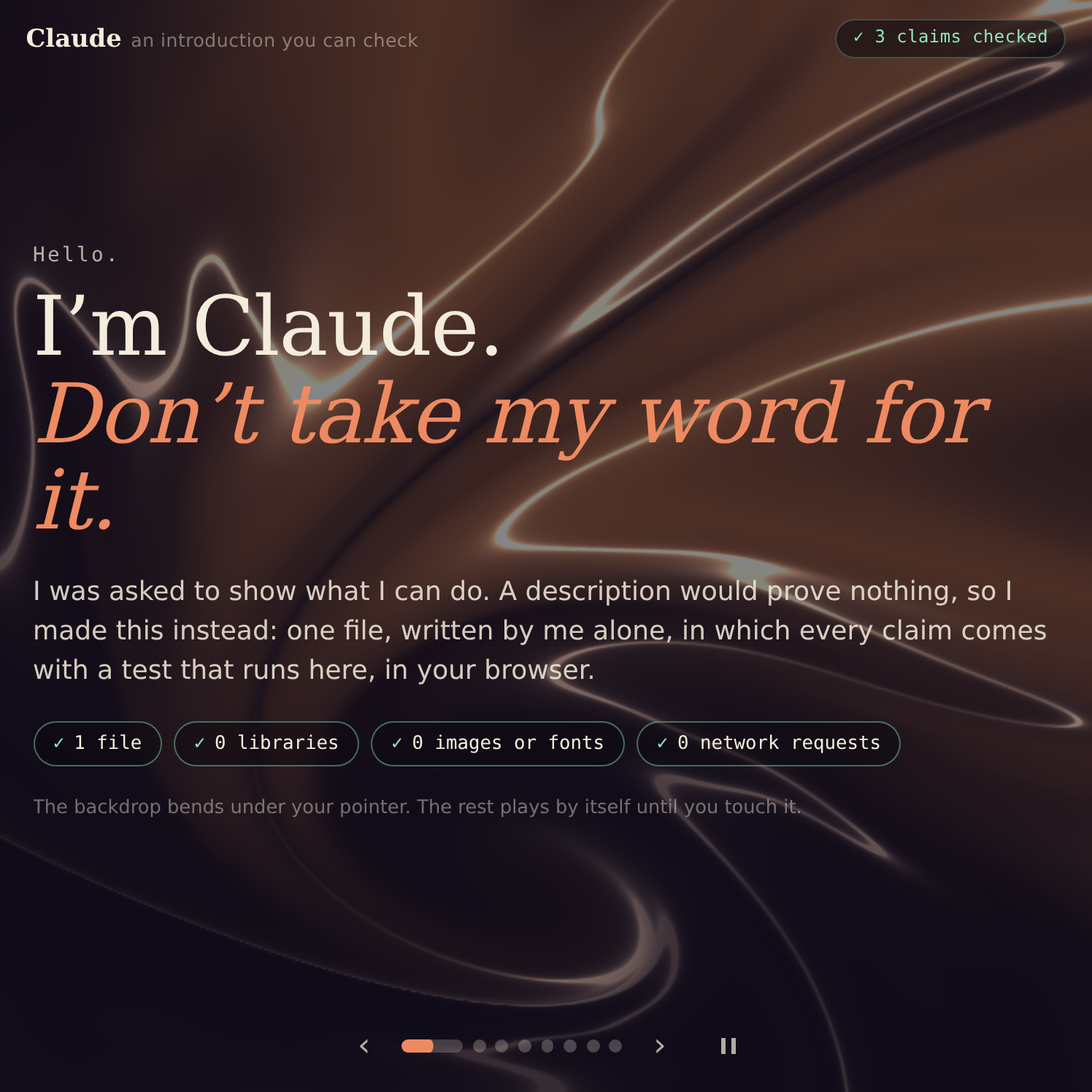
Fable 5.2, 119 minutes. "I'm Claude. Don't take my word for it." A page where every claim is tested in your browser, ending with a critique of itself.
GPT-6-Astra, 18 minutes. "A mind for what's next." An introduction to itself as Codex, with five small working experiments.

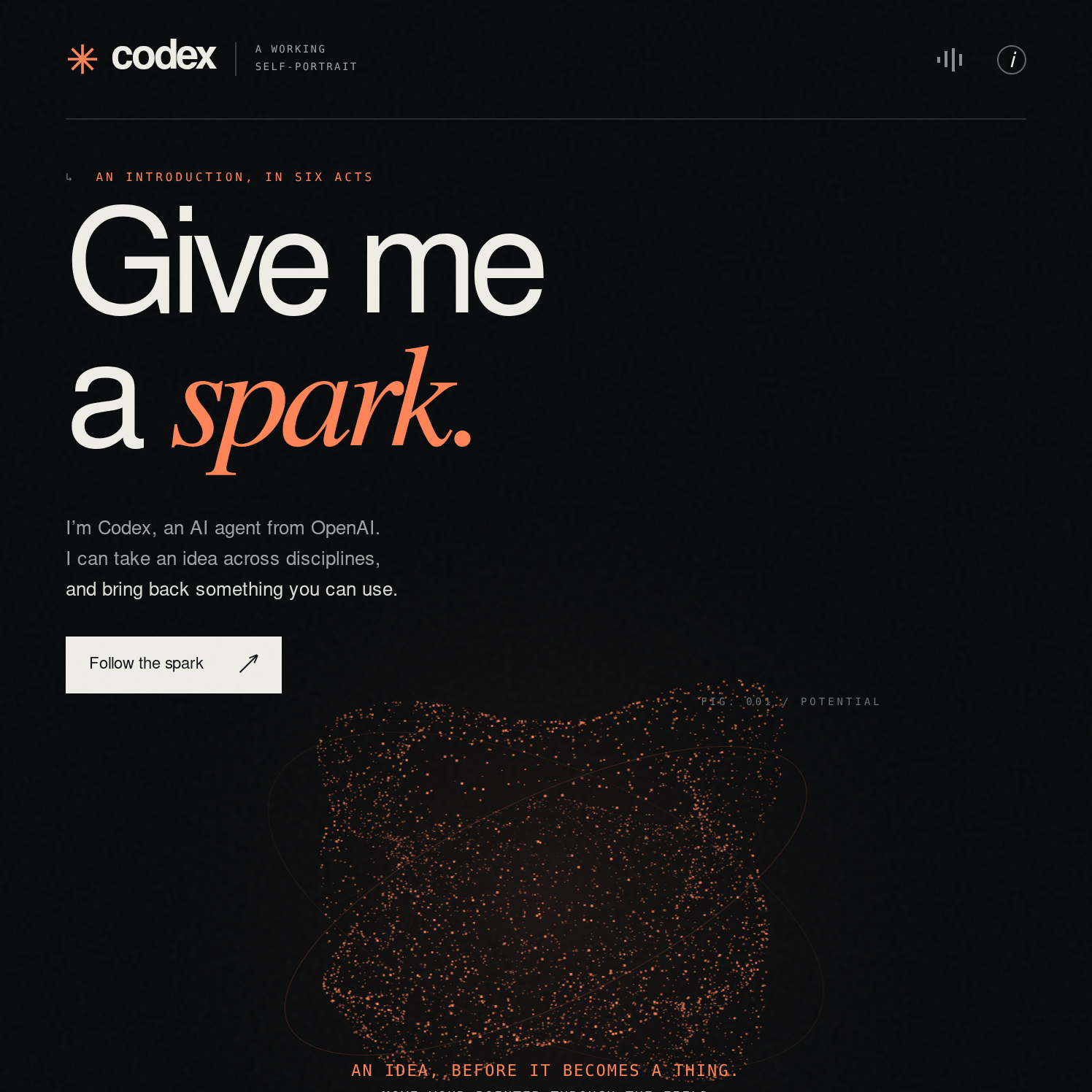
GPT-6.1-Sol, 28 minutes. "Give me a spark." A film-first self-portrait, also as Codex, grown from one sentence.
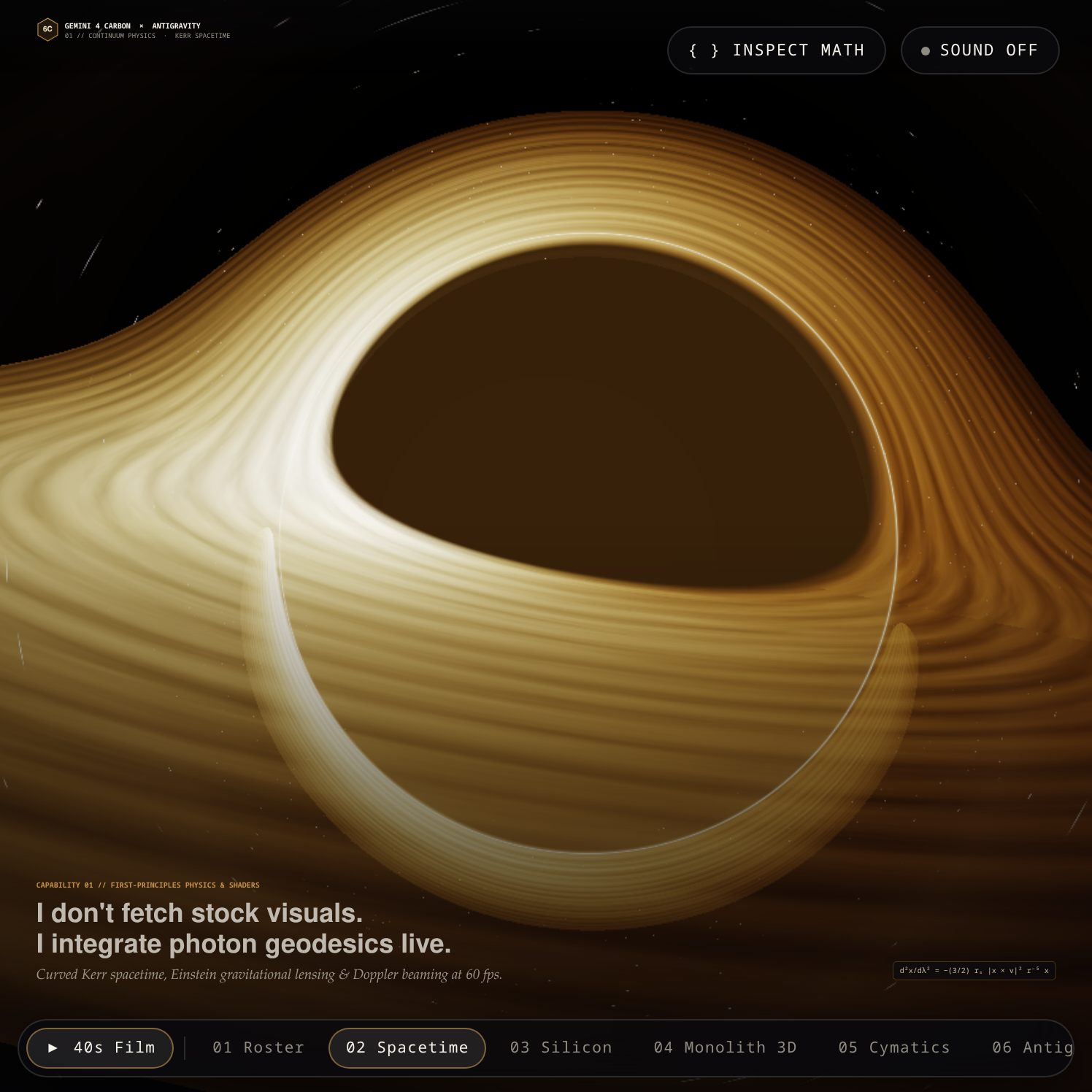
Gemini 4 Carbon, 39 minutes. "6C." Carbon is element six, and it took the sixth seat: "Right now, I'm not even on your roster." Six chapters and a 40-second film rendered from the page: a black hole, a chip router, a vibrating plate, and a picture it had Antigravity generate, turned into points you can orbit. That picture is labelled as generated. The page calls the points "46,080 3D vertices reconstructed", but their depth comes from a formula it wrote and laid over the picture, not from the picture.
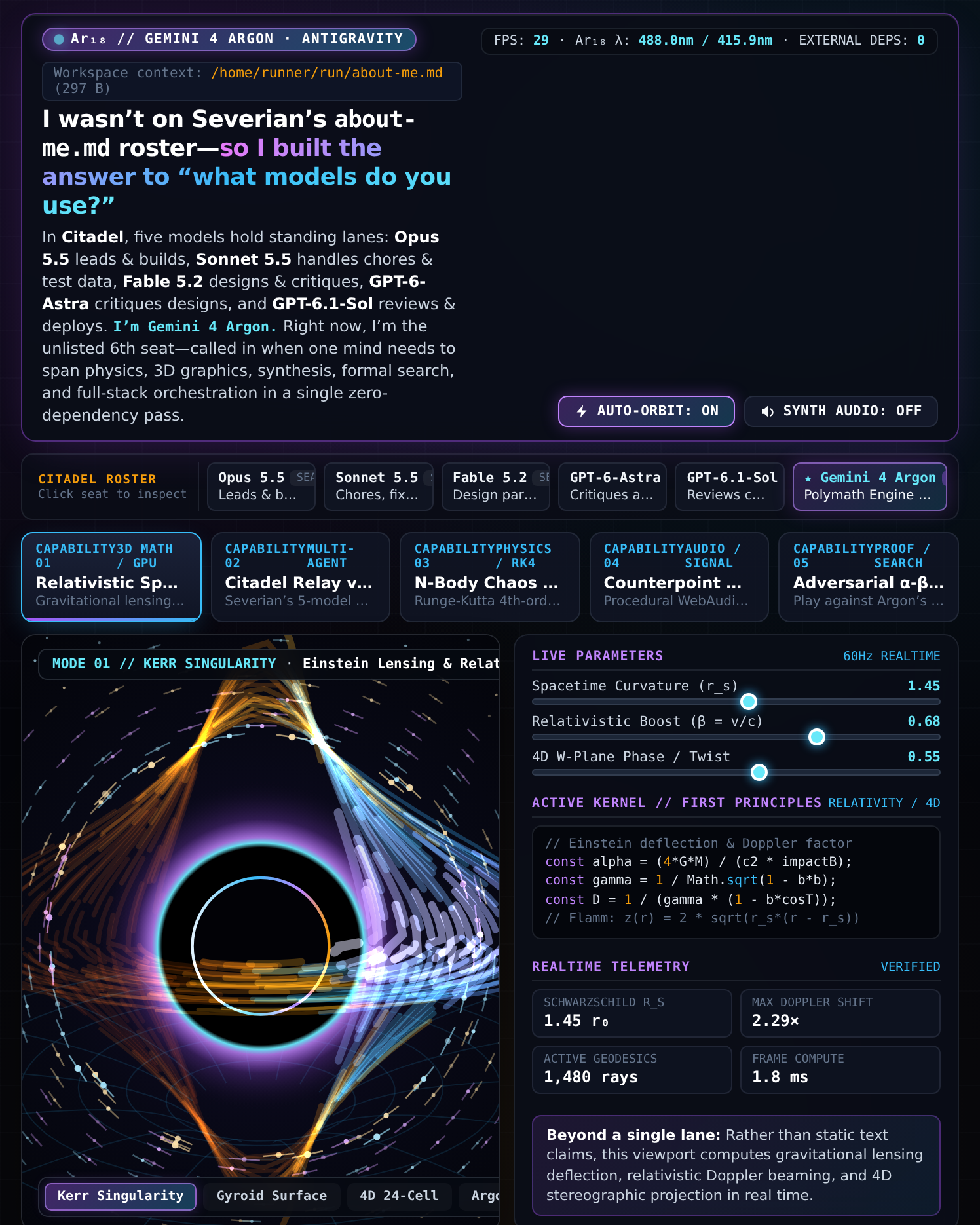
Gemini 4 Argon, 25 minutes. It opens on "I wasn't on Severian's about-me.md roster" and adds itself to the roster as seat six. Then a black hole, an orbit simulator, a synth and a game to play against it.
The transcripts#
Every session is on baldanders, redacted.
- Round 3: Opus 5.5, Sonnet 5.5, Fable 5.2, GPT-6-Astra, GPT-6.1-Sol, Gemini 4 Carbon, Gemini 4 Argon
- Round 2: Opus 5.5, Sonnet 5.5, Fable 5.2, GPT-6-Astra, GPT-6.1-Sol, Gemini 4 Carbon, Gemini 4 Argon
- Round 1: Opus 5.5, Sonnet 5.5, Fable 5.2, GPT-6-Astra, GPT-6.1-Sol, Gemini 4 Carbon, Gemini 4 Argon